
Part 4: The Participation Contract
Financing the Meantime | Part 4 of 5
Tamika Tyson, Founder and Managing Partner, SCALE | September 2026
AI helped give Nuuly’s support team a raise.
Over six months, the clothing-rental service estimates that its AI agent, Fin, performed work equivalent to $359,000 in salary costs. Nuuly used some of the benefit to support higher pay for its human support team while maintaining customer satisfaction at 95%, according to the vendor’s account.[1]
That is a different story from the one about AI replacing people. It also raises a question we can miss when the conversation moves straight from productivity to profit: who has to keep participating for the investment to work?
Employees. Customers. Suppliers. Capital providers.
Each has a reasonable request. Management has one business to run. These dependencies are familiar. What makes AI demanding is that it can change the work employees perform, the unit vendors charge for, and the cost of an acceptable alternative while the original investment is still earning back its cost. The business may have to renegotiate how it operates before it can renegotiate what it owes.
I think of that arrangement as the participation contract: the terms that keep essential people and businesses involved. Participation can reflect satisfaction, a binding obligation, or the absence of a better option. Those are different foundations for a forecast.
Earlier in this series, we examined the commitments behind the buildout and who carries the exposure when the plan changes. Part 4 asks what keeps the participants committed as the economics change.
The employees who remain may matter more to the promise.
As automation takes over routine requests, the remaining human work can require more judgment: the unusual problem, the unhappy customer, the situation that does not fit the system’s available answers. The queue may be shorter. The conversations may be harder. Even the metrics can mislead. If AI removes the easy cases, average human handling time may rise. Demanding a return to the old average could push employees to close cases faster while customers call back again. Management would be celebrating speed while buying the same problem twice.
Customers have a stake in that decision. A 2026 Gartner survey of 3,566 business and consumer customers found that 50% said generative AI made service interactions easier, while 87% considered access to a human essential.[2] Customers can appreciate automation and still need human help with the cases it cannot resolve.
A small, capable escalation team may be enough to meet that expectation. The question is which human capabilities the service requires and what it takes to retain them. Repeat contacts, successful resolution, staff turnover, and the cost of maintaining service tell us more than headcount alone. Nuuly chose to improve the employment bargain as the work changed. Another company might deliver better service with fewer people. Either decision has to earn its place in the operating results.
How much the business can afford depends partly on what customers remain willing to pay.
The customer’s alternatives determine the next negotiation.
I have found myself frustrated with every LLM. They are beginning to remind me of airlines. At some point, I want to fire them all. Then I still need to get somewhere. Which one works best today? Which gets me to the destination faster? How much inconvenience am I willing to tolerate along the way?
Enterprise buyers have more procurement meetings and more to move than a browser tab. Security approvals, integrations, reliability, and established workflows can make the incumbent worth paying for even when a competing model is cheaper. A tool can work and still become difficult to justify. The output may require too much checking. Another provider may offer better performance. An existing software supplier may include something similar in a bill the customer already pays.
Intercom’s pricing makes the negotiation visible. Its helpdesk still carries seat charges, while Fin is priced at $0.99 per outcome. The company can earn from automated work even when that work does not require another human seat.[3] The chair is still on the invoice. Now the bot’s work is too.
For the buyer, the value of that outcome matters. Was the problem resolved? How much human work remained? Did the service improve, or did the bill simply acquire another line? The demonstration gets applause. The renewal gets a budget line.
I would look beyond the renewal rate to the prices retained customers pay, the concessions required, and how much useful work they continue buying. And the customer’s alternatives can change quickly. Stanford’s 2025 AI Index reported that the inference price for systems matching roughly GPT-3.5 performance on a specified benchmark fell more than 280-fold between November 2022 and October 2024.[4]
The customer’s full implementation cost need not fall at the same rate. But cheaper model capability can improve its alternatives. Whether those alternatives strengthen its negotiating position depends on the cost and difficulty of moving. That is bargaining power. A disappointed customer with no practical substitute may keep paying. A satisfied customer with several credible alternatives may still demand a discount. Retention alone will not tell us which relationship we own.
If preserving the relationship requires a discount, the provider must find room for it alongside the employee capabilities and service standards it still needs. That can lead to a negotiation with its own suppliers.
A supplier’s discount can become the buyer’s commitment.
The picks-and-shovels argument has an understandable appeal. Supply the tools, and you do not have to choose which customer strikes gold. You still need enough customers who can afford to keep digging.
Software vendors, cloud providers, chipmakers, data centers, and power companies have different economics. Each needs a reason to keep delivering and, where necessary, to invest ahead of demand. The buyer wants lower prices and room to change its mind. The supplier may offer the price in exchange for a minimum purchase, a longer agreement, or earlier payment. The saving comes with a commitment.
CoreWeave’s March 2026 financing shows why commitments matter. Its $8.5 billion facility is backed by infrastructure and an underlying customer contract. The approximately six-year facility provides for monthly amortization after specified stabilization triggers, with full repayment scheduled by maturity.[5] The customer’s commitment helps make the supplier’s investment financeable. Capital can be advanced against something more substantial than enthusiasm about AI.
The buyer here is an investment-grade AI enterprise, with resources and obligations very different from those of a business renewing a support tool. The lender needs to understand this buyer’s ability to pay under this contract. General enthusiasm for AI will not make the payment. A long agreement can secure capacity and support better pricing. It can leave the buyer paying for capacity after its own customers require lower prices or less of the service. The payment obligation and the usefulness of the purchase are separate questions.
The flexibility one participant wants is often the uncertainty another needs removed before investing. Who concedes depends on alternatives. A scarce supplier may require commitments without offering much of a discount. A buyer able to move its workload can negotiate from a stronger position.
Capital finances the time between everyone’s decisions.
Consider a business that invests in experienced staff, discounts its service to retain customers, and secures cheaper capacity through a longer commitment. Each choice may be sensible. Together, they determine how much cash the business needs and when. Now suppose customers can reconsider annually while capacity is committed for several years. If renewal prices fall before delivery costs can adjust, the business must fund the difference. Growth helps only to the extent that additional customers contribute cash after the cost of serving them.
Management can accept a lower return, seek more capital, renegotiate supply, or reduce spending elsewhere. Each choice reaches someone whose continued participation it needs. Cutting experienced staff may protect this quarter’s cash and weaken the next renewal. Negotiating a supplier discount may require extending the very commitment management wants to shorten. New equity may buy time at a price existing investors find uncomfortable.
That is why I would put dates beside the assumptions. When can customers leave or reprice? When can the business reduce its purchases? When must the lender be paid? How much cash is available between those dates? An attractive eventual return does not settle whether the business can finance the route to it.
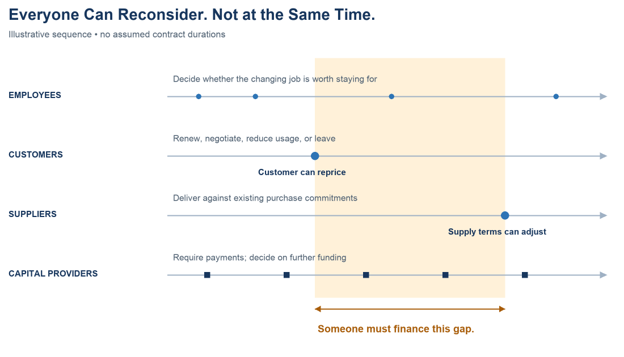
A customer can make a rational decision to spend less before the business can reduce its obligations. The resulting funding need connects customer value, supplier commitments, employee decisions, and capital.
The strongest participant cannot remove every dependency.
An unequal bargain can last. A company may hold customers through switching costs, replace departing employees, or press suppliers to accept thinner margins. The investment depends on how durable that position is. Scarce capacity may give a supplier leverage today. A credible substitute may shift it to the buyer tomorrow. For each essential relationship, identify the reason to stay, the next best alternative, and the next opportunity to change the terms. Then estimate the cash required if that change arrives before the business can adjust its own obligations.
Those answers should shape the liquidity the business needs, the commitments it can afford, and the evidence required before financing the next stage.
Our story began with a raise. Sustaining it depends on the customer, supplier, and financing relationships around it. The financing examined earlier in this series rests on those operating relationships. A contract may support a loan. The next contract still needs a willing buyer. Before assuming everyone stays, I want to know why they would and what it will cost when someone’s answer changes.
Next in the series: Part 5 brings those dependencies into the investment decision, examining which assumptions can be supported and what happens when they change together.
Source notes
[1] Fin, “How Nuuly turned AI savings into higher pay for its support team.” Vendor-published account; $359,000 represents estimated salary-equivalent savings, not a disclosed net cash return. The account does not establish a causal effect of pay changes on employee retention. Source.
[2] Gartner, “Gartner Survey Finds 87% of Customers Say Companies Using GenAI for Customer Service Must Provide Access to a Human Agent,” August 4, 2026. Survey of 3,566 B2B and B2C customers conducted February–March 2026; Reported attitudes do not establish staffing requirements, willingness to pay for human access, or observed renewal behavior. Source.
[3] Intercom, pricing page, accessed September 21, 2026. Outcome definitions and charges depend on service and configuration. The article discusses possible renewal pressures; it does not report observed Intercom churn or renewal concessions. Source.
[4] Stanford HAI, 2025 AI Index, Research and Development. Benchmark-specific inference pricing comparison, November 2022–October 2024; not a measure of total enterprise implementation costs. Source.
[5] CoreWeave, “DDTL 4.0: $8.5 Billion First-of-a-Kind Facility,” March 2026, pp. 3–4. Scheduled repayment is not guaranteed repayment. The article’s pricing and commitment scenarios are illustrative. Source.