
Part 3: The Same Buildout. Different Stakes.
Financing the Meantime | Part 3 of 5
Tamika Tyson, Founder and Managing Partner, SCALE | September 2026
In April 2026, Amazon and Anthropic announced a deal that put money on both sides of the relationship. Amazon would invest another $5 billion in the developer of Claude. Anthropic committed more than $100 billion over ten years to Amazon's cloud technologies, securing up to five gigawatts of computing capacity.[1] An investor could look at that agreement and see considerable reassurance. Amazon knows the technology, has money at stake, and expects years of business from the company it is backing. Its confidence deserves attention.
What catches my attention is how many things Amazon can gain from the same decision. It holds an investment, supplies computing, and develops chips used in the relationship. Someone buying a supplier's shares at today's price brings a different set of economics to the deal. Amazon can make a sound decision for Amazon while that investor earns less than expected.
The biggest names in technology are answering questions about their businesses. We still have to answer questions about our own investments.
A supplier waiting for the next order has its own calculation, especially if it has already expanded the factory. The customer's overall plan can remain on track while the order the supplier needs moves into next year. My concern is how easily confidence in the customer becomes reassurance about every investment around it.
Whose investment needs to work?
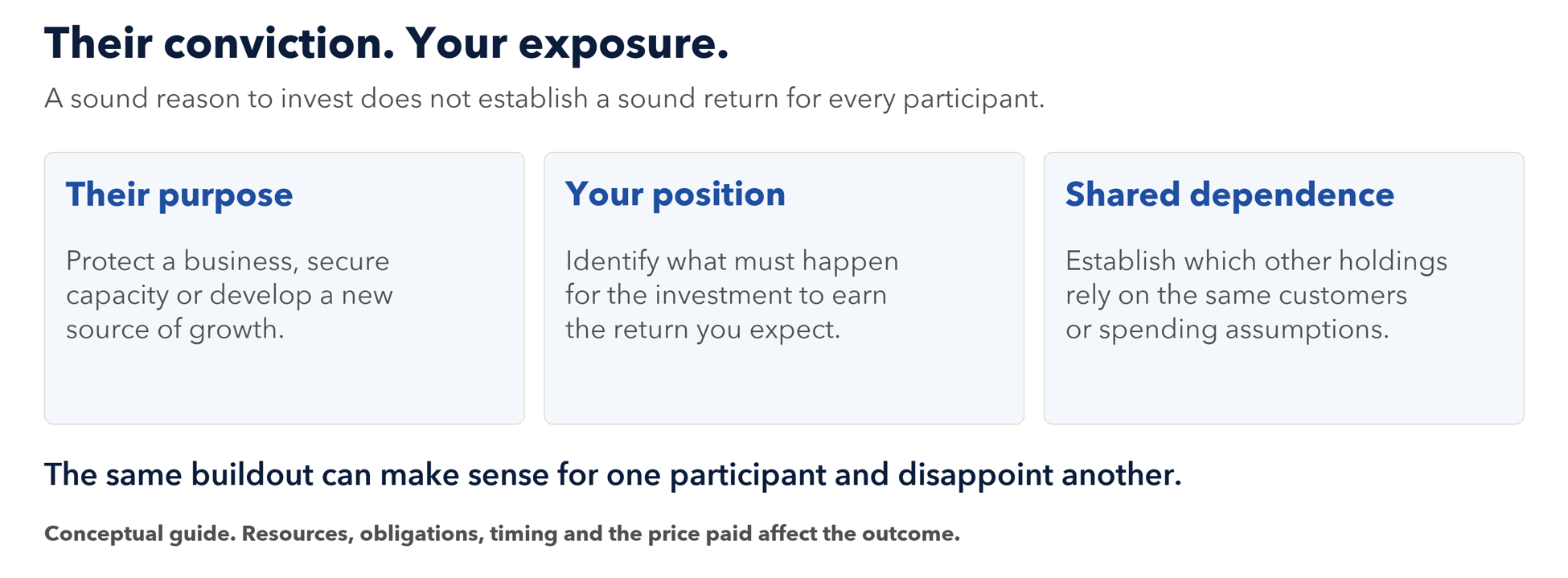
Meta's Hyperion campus makes the different stakes easier to see. In October 2025, Meta announced a joint venture with funds managed by Blue Owl to develop approximately $27 billion of buildings and long-lived infrastructure for its Hyperion data-center campus. Meta would own 20% and the funds 80%.[2] Meta later expanded the campus plan beyond the scope of the originally disclosed venture.[3]
S&P's October 2025 assessment described minimum rent payments even when the facilities are not fully used, along with guarantees supporting their residual value. Creditors depend heavily on Meta's ability to honor those promises; S&P also identified limitations in the security available to them.[4] If the business benefits take longer to arrive, supported payments could continue while Meta carries more of the cost of waiting. Shareholders would still need the benefits to justify the spending. A shareholder can be disappointed by precisely the arrangement that keeps a creditor paid.
The size of Meta's promise matters too. It disclosed $46.03 billion of maximum exposure to loss associated with the venture at June 30, 2026. That includes its investment alongside lease commitments, estimated future funding, and contingent residual-value guarantees. The leases are scheduled to begin in 2029, so the burden depends on when cash is required and which conditions are met.[5] Meta generated $64.1 billion of operating cash flow in the first half of 2026. Capital expenditure and finance-lease principal payments left $13.2 billion of free cash flow.[6] The business earns substantial cash, and expansion is absorbing much of it.
The cash-flow figures cover six months across the whole company; the venture's obligations stretch over years. What matters is the cash Meta can make available as those obligations arrive, after funding the rest of its business. Its established operations give it room to manage competing demands. A financing vehicle built around one project, or a supplier counting on one large order, may have far less room. Meta's financial strength cannot be borrowed simply by appearing beside it in the same deal. Management says AI is improving recommendations and advertising tools in Meta's existing business.[7] Those benefits help explain the spending, although Hyperion's own return remains a separate question. Better products could defend an established business while competition absorbs some of the benefit through continued investment or better terms for customers.
Defending a profitable business can produce an excellent return. A shareholder who paid for substantial new growth, however, needs more than a successful defense. The price paid determines how much more the shareholder needs.
How much room is there to be wrong?
An exposure becomes harder to carry when funding it begins to crowd out something else. A company can carry a delayed return for years if the rest of the business supplies enough cash. Several projects needing money at once put a different demand on that business.
Suppose cash generation weakens while committed spending stays high. The project now competes for a smaller pool of cash, even if its cost has stayed exactly where management expected. A setback elsewhere in the business has made the same commitment harder to carry.
Management then has choices to make. Borrowing can preserve the plan at an additional cost. Cutting another investment can protect cash while reducing someone's expected orders. Shareholders and suppliers feel those decisions while the company still has ample ability to pay its bills.
Part 2 followed the commitments left behind when a customer changes its plans. For the supplier, the next question is how much of its earnings depends on that customer's next order and how much of our portfolio depends on the supplier.
Different investments, a shared assumption
Amazon's relationship with Anthropic brings us back to a company investing in its own customer. It also shows why an early success deserves another look as it grows. Through June 2026, Amazon had invested $18 billion in Anthropic. At June 30, the reported values of its preferred stock and convertible notes totaled $190.4 billion. The holdings follow different accounting treatments, and that reported value had yet to be realized in cash.[8]
A decline could leave an early investment well ahead of its original cost while erasing value that has become important to its owner. Amazon's shares need not reflect the reported value dollar for dollar. Even so, “we got in early” tells us little about how much value is exposed today. The commercial side is still developing as well: AWS receipts depend on performance over the life of Anthropic's spending commitments.
The agreement helps both companies: Anthropic secures computing capacity, and Amazon gets a customer to help justify its investment. Amazon also holds an investment whose value depends on that customer's success. Count the investment gain and the expected AWS sales as separate votes of confidence and the same customer gets counted twice.
There are ways for that relationship to absorb a setback. Cheaper computing could improve Anthropic's economics, and greater demand or efficiency could compensate AWS for lower revenue per unit. The pressure builds if the customer's economics weaken while the capacity built to serve it still needs funding. Amazon could then face a falling investment value and a reason to put more money into the relationship. Whether it does so depends on what it has promised, what it stands to preserve, and what else needs the money.
Amazon has other businesses and substantial earning capacity. Its companywide trailing-twelve-month operating cash flow was $161.4 billion at June 2026, while free cash flow was negative $7.6 billion amid heavy investment.[9] Further support would compete with that spending. Amazon's resources give it choices that a smaller company may lack. An investor elsewhere in the relationship still has to establish what support reaches the position they own.
Follow the money through the six layers from Part 1 and the same spending assumption can turn up repeatedly. A model developer's forecast helps support a computing provider's capacity plan, which supports equipment orders and expected power demand. Each business has its own economics, but several expected returns can come back to the same customers paying enough to make the expansion worthwhile.
The portfolio can feel it before anyone misses a payment
Now suppose AI adoption continues, but customers capture more of the benefit than investors expected. Competition reduces prices, costs stay higher for longer, or new capacity takes more time to earn its keep. Useful technology and growing usage can coexist with lower expected returns. The leading companies may keep investing throughout.
Part 2's Microsoft example showed how several businesses counting on a company's plans can experience larger share-price declines than the company itself, amid other market pressures.[10] Higher required returns reduce what investors will pay for future cash. Less dependable growth can also persuade them to pay a lower multiple of earnings. Add weaker earnings expectations and a shareholder can take two hits while the company continues to pay every bill.
Someone holding debt connected to the same company would have a different calculation. Supported payments might remain intact, but a bond's market value could still fall if buyers demanded a higher return. The holder's need to sell would then matter alongside the borrower's capacity to pay.
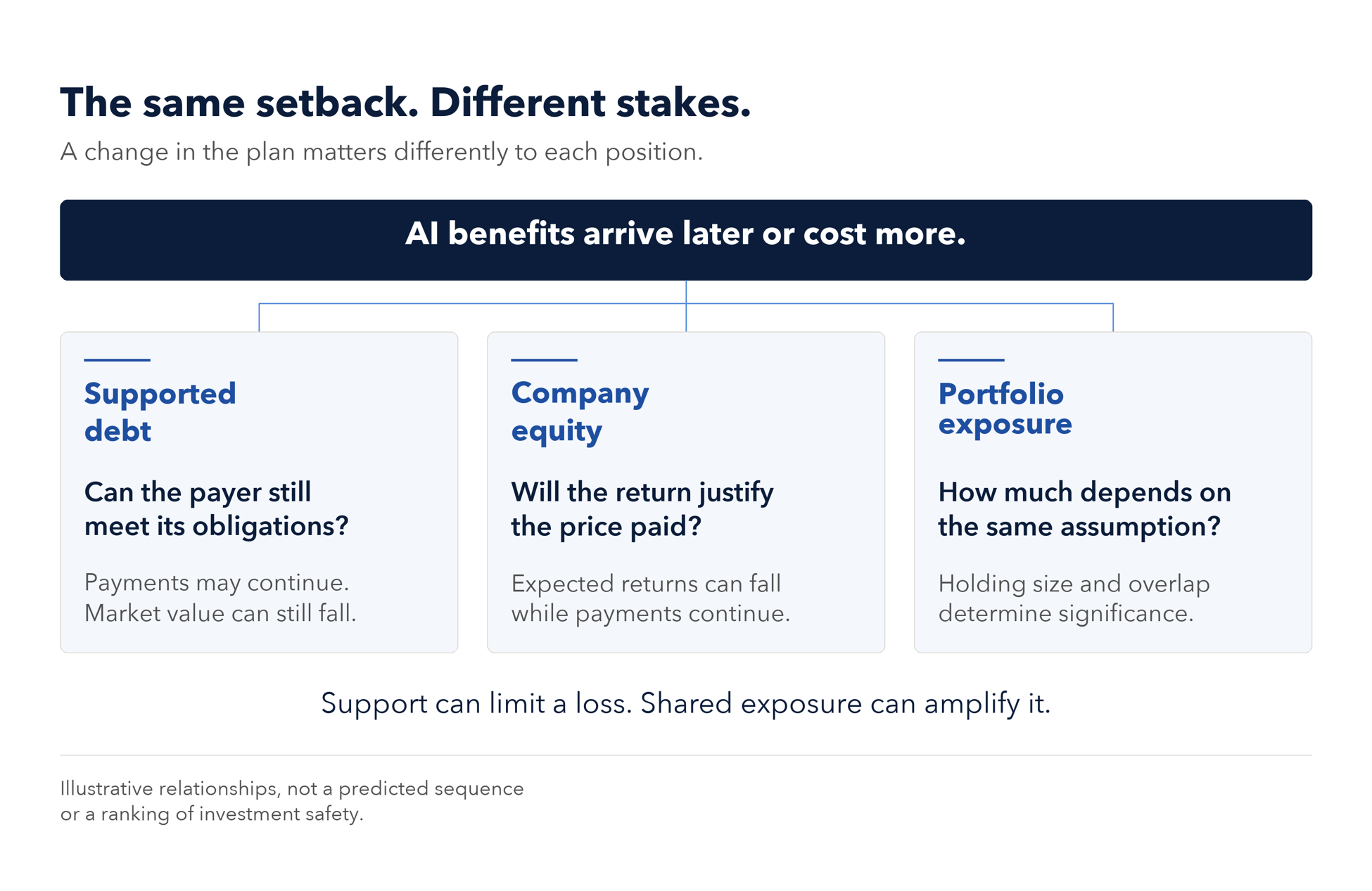
Different claims can respond differently to the same disappointment. The portfolio consequence depends on how much is held and what else shares the exposure.
A commitment that Amazon or Meta can absorb may still be consequential for a supplier counting on the next order, or for an investor with a large holding in that supplier. Several smaller holdings can add up to a substantial dependence on the same spending plans. I would look at how much of the portfolio relies on those plans, then at what gives each business room to adjust. Different company names are a starting point for understanding diversification.
The protections still matter. Dependable payments from a financially capable customer can support one business while another waits for new orders. That gives the investor a reason to distinguish the exposures, even when both companies serve the same buildout. The significance also depends on when the investor needs cash: selling during a setback can turn a decline in market value into a realized loss.
There is evidence that should increase confidence, too. Paying customers supporting attractive margins, new capacity earning its keep, and less dependence on repeated financing would give a business more room to absorb disappointment. An investor who sees those improvements can reassess the exposure on better information. The same discipline that identifies a weakness should recognize when the economics are getting stronger.
I can believe in the opportunity and still question how much success my investments already require. The leading companies will keep making decisions to protect their businesses, and some of those decisions will strengthen the investments around them. Others will shift the cost of waiting. Owning several pieces of the buildout can leave a portfolio counting on the same growth several times. The company names alone will not tell you how much room you have to be wrong.
Part 4 examines the operating relationships behind these expected returns: what keeps employees, customers, suppliers, and capital providers participating, and what happens when they can change their terms at different times.
To discuss where these dependencies sit in your business or portfolio, and how SCALE can help assess their significance, reach me at tamika@tamikatyson.com.
Source notes
[1] Anthropic, April 20, 2026. Expanded Amazon compute collaboration. Commitment and capacity figures are company-announced; they are not cash receipts or completed capacity. Source
[2] Meta, October 21, 2025, updated November 14, 2025. Joint venture announcement. Ownership and estimated development scope; the funds are distinct from Blue Owl's corporate balance sheet. Source
[3] Meta, July 13, 2026. Richland Parish expansion announcement. The analysis concerns the originally disclosed venture. The public disclosures reviewed do not establish that its financing covers every phase of the larger expansion. Source
[4] S&P Global Ratings, October 23, 2025. Beignet Investor LLC debt issuance assessment. Sections on lease support, residual-value guarantees and security. This is the agency's assessment at issuance, not a statement of a verified current rating or an assurance of investment return. Source
[5] Meta, Form 10-Q for June 30, 2026, Note 5, printed pages 17–18. Maximum exposure aggregates the disclosed categories; its components should not be added again. Residual-value payments are conditional. Source
[6] Meta, July 29, 2026. Q2 2026 results, six-month cash-flow reconciliation and balance-sheet context. Operating cash flow of $64.088 billion and free cash flow of $13.170 billion are rounded in the text. Free cash flow is the company's non-GAAP measure. At June 30, 2026, Meta also reported $90.26 billion of cash, cash equivalents and marketable securities and $83.66 billion of long-term debt; these are companywide balances, not resources or obligations attributable solely to Hyperion. Source
[7] Meta, July 29, 2026. Q2 earnings call transcript, opening remarks. Statements about AI's contribution are management's attribution, not an independently measured return on Hyperion. Source
[8] Amazon, Form 10-Q for June 30, 2026, Note 2, printed pages 11–12. Funded total: $8 billion through 2025 plus two $5 billion investments in Q2 2026. Combined reported value: $92.5 billion plus $97.9 billion at the same date. Future financing availability is excluded from the funded total. Source
[9] Amazon, July 30, 2026. Q2 2026 results. Cash-flow figures cover the preceding twelve months and the whole company. They are not resources attributable solely to Anthropic. Source
[10] Reuters, February 24, 2025. Microsoft data center leases slowing, analysts say, raising investor attention. Contemporary reporting on the TD Cowen analyst note, Microsoft response and share-price moves amid broader Nasdaq selling. The price changes cannot be attributed entirely to the lease report. Source