
Part 2: When the Plan Changes
Financing the Meantime | Part 2 of 5
Tamika Tyson, Founder and Managing Partner, SCALE | September 2026
Microsoft agreed to buy electricity from a nuclear plant that hadn't restarted, and Constellation's shares rose 22.3% in a day. The 20-year power agreement announced in September 2024 supported the planned restart of Three Mile Island Unit 1.[1][2] The electricity would come later. Investors were already putting a price on the promise of it.
Five months later, a TD Cowen report that Microsoft had canceled some data-center leases unsettled power and electrical-equipment shares. Microsoft said its annual investment plan remained on track. Against a broader Nasdaq selloff, its shares fell about 1%, while Constellation fell 5.9%, Vistra 5.1%, Siemens Energy 7% and Schneider Electric 4%.[3] The report wasn't the only force moving prices that day, but several businesses counting on the buildout experienced larger percentage declines than Microsoft itself. You didn't need to own Microsoft to have an investment riding on its plans.
Microsoft separately confirmed in April 2025 that it was slowing or pausing some projects.[4] By then, investors had been reconsidering the outlook for weeks. Other companies had committed money while those plans were still taking shape. Their ability to respond depended on earlier agreements.
Across the six layers introduced in Part 1, one company's plans become part of another company's investment case. A model developer seeks computing capacity; its provider orders equipment and secures power. Money is committed along the way, often before the final customer has paid for anything.
The shares can adjust in seconds. The agreements take longer.
Changing the plan doesn't cancel the commitment
Management can revise a forecast in an afternoon. Whether it can revise an equipment order or a lease depends on what it signed. That is where I would follow the announcement: into the commitments made before the plan changed. The distinction matters when the announcement concerns the technology itself. This September, Anthropic chief executive Dario Amodei proposed pacing advances in frontier models to give safety work more time, while training and technical progress continue.[5] A supplier trying to interpret that proposal still needs to know what happens to orders. The essay alone does not establish a reduction in infrastructure spending.
Microsoft reported $329.1 billion in additional leases that had not yet commenced as of June 30, 2026, primarily for data centers, with some arrangements subject to contractual conditions.[6] Payments and capacity lie ahead. The disclosure gives the scale of the commitment; the individual agreements determine how much room Microsoft has to delay or cancel it.
A tenant postponing capacity may be exercising sensible capital discipline. Its developer may have borrowed against the rent it expected to receive. Both can agree that waiting makes commercial sense and still disagree about who should pay for it.
Equipment orders carry the same tension. If you cancel an order, the supplier may be left with inventory. Make the purchase commitment firm and the buyer may be left with equipment it cannot yet use productively. Reserving capacity creates another set of obligations, sometimes without transferring ownership at all.
Electricity makes the cost of that flexibility particularly visible. Under AEP Ohio's data-center terms, service begins on actual energization, with a load ramp of up to four years and minimum demand charges under a specified formula. Before that, its Letter of Agreement provides for reimbursement of buildout costs when a customer cancels or delays the project by more than 12 months before the target energization date.[7]
AEP is spending money to serve an expected customer. The terms protect certain construction costs and support cost recovery after connection, while the customer's own receipts may still be developing. Reserving access to power comes with limits on how cheaply the customer can change its mind. That protection may be exactly what makes the project possible. Removing it would give the customer more freedom while leaving someone else to finance the uncertainty.
Sometimes the customer supplies the financing
Oracle received $11.4 billion of customer prepayments containing a significant financing component in the quarter ended August 31, 2026, before delivering the corresponding goods or services. The figure covers the company as a whole.[8] Its customers were helping finance the wait.
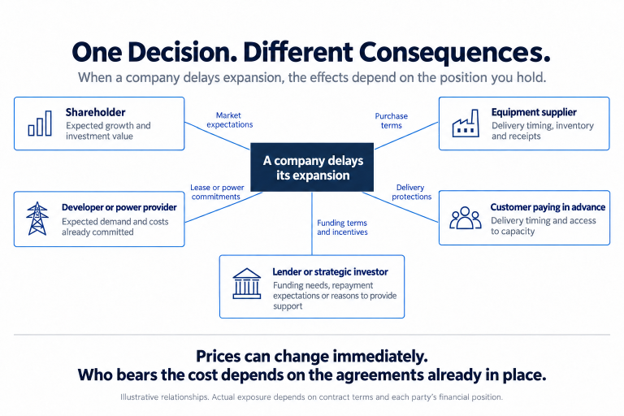
Paying early can secure access to what a customer values and give the provider money to deliver it. The customer then has cash tied up before performance. A delay makes the delivery protections and refund provisions consequential: the customer may need both the service and the cash for its own plans.
There is a trade here. Insisting that a supplier carry every cost until delivery can protect a customer's cash while weakening the supplier's ability to deliver. A customer can negotiate an impressive set of protections and still be left waiting for the service it needs.
A review that stops at the lenders misses the customer whose advance is helping hold the project together. That customer has cash committed and a service still to receive.
A distant maturity can hide a nearer payment
CoreWeave's May 2026 equipment-financing facility offers up to $3.1 billion of borrowing capacity. Principal installments begin in November 2026, with the final payment expected in May 2031. Another facility, maturing in March 2032, ties earlier repayments to specified triggers, including provisions for sites missing delivery requirements.[9] May 2031 sounds comfortably distant. November 2026 is the first payment the borrower has to prepare for.
A borrower facing a November payment needs cash available by November. A large facility helps only if its borrowing conditions can be met in time. I would look at that first payment alongside the expected customer receipts and the cash already available. The final maturity comes much later in the story.
Demand can exceed expectations and still create a financing need. The business may need to buy equipment and capacity before the additional receipts arrive. The business can grow into its opportunity while investors are asked to fund more of it.
“Someone will refinance it” is doing a considerable amount of work in that forecast. Someone may. The next investor gets to name a price. If the company raises equity at a lower valuation, it may have to sell a larger ownership share to raise the same amount of cash. More expensive debt leaves less of the operating return for shareholders. Higher required returns also reduce what investors will pay for a given stream of future cash, all else equal.
The cost of that next dollar is changing too. On September 16, the Federal Reserve raised its target range by a quarter percentage point to 3.75%–4.00%.[10] For a project still waiting to earn its return, a higher financing cost adds to the cost of waiting. The rate increase reaches different obligations at different speeds. Existing fixed-rate debt retains its agreed rate. Floating-rate borrowing changes under its terms, and hedges can limit the effect. Prices may already reflect an anticipated increase; the accompanying guidance can still change expectations about what comes next.
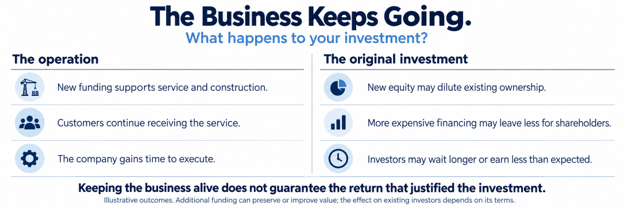
The company can keep serving customers and building capacity while existing shareholders give up more of the return they expected. Staying in business can be an expensive success.
A partner can preserve the business without preserving your return
The next dollar may come from someone already involved, with priorities different from yours. Microsoft's April 2026 description of its amended OpenAI partnership identifies it as an investor and primary cloud partner, with continuing intellectual-property rights and revenue-sharing payments from OpenAI.[11] A shareholder who owns only equity has fewer interests to protect.
A strategic partner may provide more money to preserve technology access or a customer relationship. The support can keep the business operating while changing what other investors own or receive. The agreements establish the support owed. Beyond those obligations, additional money must compete with the partner's other uses of cash. Before relying on it to bridge a delay, the borrower needs to establish what is committed and when it can be drawn.
What did the deal give you the right to do?
By the time a company announces a change of pace, its counterparties have already negotiated much of their room to respond. Buying flexibility earlier can cost more. Giving it up can make access cheaper or secure capacity that would otherwise go to someone else.
A smaller customer may have little influence over a supplier's terms, especially when capacity is scarce. That can be a reasonable trade. The investment case still has to allow for the cost of being unable to change course when the forecast changes.
Return to the developer waiting on the customer's decision. The customer can make a sensible choice to wait while the developer still owes interest and the supplier still carries inventory. By the time work resumes, someone may have accepted a lower return or supplied more capital to keep it moving. The project can get back on schedule without restoring the return anyone originally expected.
Part 3 takes the next step: how much of those plans do we own? A company may have the resources to absorb a setback while its suppliers or shareholders feel it sharply. Following the exposure into earnings and portfolios shows when it becomes large enough to matter, including to retirement assets.
To discuss how these relationships affect your business, portfolio, or board's decisions, reach me at tamika@tamikatyson.com.
Source notes
[1] Constellation, September 20, 2024 announcement of a 20-year Microsoft power purchase agreement supporting the planned restart of Three Mile Island Unit 1 as the Crane Clean Energy Center. Source
[2] Associated Press, September 20, 2024 closing market report. Constellation shares rose 22.3% on the announcement day. Source
[3] Reuters, “Microsoft data center leases slowing, analysts say, raising investor attention,” February 24, 2025. TD Cowen report, Microsoft response and contemporaneous share-price moves; broader Nasdaq selling also noted. Source
[4] Associated Press, “Microsoft says it is slowing or pausing some AI data center projects, including $1B plan for Ohio,” April 9, 2025. Separate confirmation from the February analyst report. Source
[5] Dario Amodei, “We Must Pace the Frontier,” September 2026. Proposal concerns pacing frontier capabilities while training and technical progress continue. Source
[6] Microsoft, fiscal 2026 Form 10-K, Note 13, Leases. $329.1 billion of additional leases not yet commenced at June 30, 2026, primarily data centers; some arrangements subject to contractual conditions. Source
[7] AEP Ohio, Data Center Tariff, accessed September 18, 2026. Actual energization begins service; load ramp up to four years; minimum demand-charge formula. Letter of Agreement provides buildout-cost reimbursement for cancellation or customer delay exceeding 12 months prior to target energization. Source
[8] Oracle, Form 10-Q, quarter ended August 31, 2026, Note 1, Customer Prepayments and Sales of Financing Receivables. $11.4 billion of customer prepayments with a significant financing component in fiscal 2027 Q1. Source
[9] CoreWeave, Form 10-Q, quarter ended June 30, 2026, Note 10, Debt. DDTL 5.0: $3.1 billion facility capacity; installments begin November 2026; expected final payment May 2031. DDTL 4.0: March 2032 maturity with earlier repayments triggered by specified events, including delayed-site provisions. Source
[10] Federal Reserve, FOMC statement, September 16, 2026. Quarter-percentage-point increase to a 3.75%–4.00% target range. Source
[11] Microsoft, “The next phase of the Microsoft-OpenAI partnership,” April 27, 2026. Investor and primary cloud partner; continuing IP license and revenue-sharing payments from OpenAI to Microsoft. Source