
Part 1: The Revenue Is Real.The Financing Still Has to Work.
The Financing Behind the AI Buildout | Part 1 of 5
Tamika Tyson, Founder and Managing Partner, SCALE | September 2026
Amazon is the company I keep coming back to when I hear that AI spending cannot possibly make sense. In his 1997 shareholder letter, Jeff Bezos asked investors to judge a business he was still building, with customers and infrastructure taking priority over short-term earnings. He also explained the cash, investments, and borrowing that gave him room to pursue it. The financing was part of the ambition, even then.[1]
I am willing to give AI that same room in the argument. The models can improve, customers can find more valuable uses for them, and spending that looks excessive today may eventually prove worthwhile. But being right about the technology does not settle whether the companies financing it can meet their obligations along the way. Amazon gives us a reason to take the upside seriously, not permission to stop reading the financing terms.
Follow the money through this buildout and the difficulty becomes clearer. Investors supply capital to AI companies, those companies spend it on computing, and some of the suppliers receiving that spending also invest in their customers or support their obligations. The revenue can be real throughout that chain. My concern is how many agreements depend on the same future cash flow, how much has to go right together, and who can afford to wait when it doesn't.
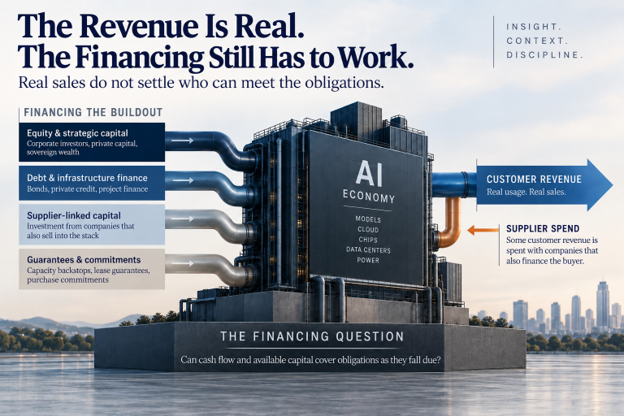
Conceptual illustration. Guarantees and purchase commitments can support financing without representing funded cash.
You may already depend on part of this structure. A cloud provider's capacity commitment can sit inside your operating plan; expected AI savings can sit inside the price of a services contract. A pension fund can lend through private credit without buying shares in an AI lab. The financing matters well beyond the companies whose names appear in the announcements.
Consider a data center whose building, servers, and debt belong to different companies. A cloud provider leases space and power from a developer, obtains hardware through another arrangement, and sells computing services to its customers. A separate legal entity, often called a special-purpose vehicle or SPV, may own an asset and borrow against the income expected from it.
The developer needs its rent, the hardware owner needs its lease payments, and the lender needs debt service. Those payments may ultimately depend on the same customer. If the customer's cash arrives late, several companies can be left waiting while their own bills come due. Separate agreements give each party a different claim; they do not create separate sources of demand.
What do people mean by the AI bubble?
Calling all this an AI bubble puts several different problems into one argument. Paying too much for an ownership stake is different from building capacity that cannot earn an adequate return. A borrower can also have a worthwhile business and run out of time to produce the cash its financing requires. These problems can reinforce one another, but diagnosing one does not establish that all three are happening everywhere.
Following those payments requires knowing who participates. The buildout has six connected layers, each with its own sources of income and obligations.
Double-click to edit...
Some companies occupy several layers. Google develops models, sells cloud services, and designs processors; corporate investors can also be suppliers. The roles overlap, but the obligations remain specific to each agreement.
The customer at the end of this chain may be delighted with the service while someone further back struggles to earn a return. A model developer has to cover the cost of serving that customer. A cloud provider needs demand for its capacity, and a building owner needs payments that support the facility and its financing. Revenue growth at one layer tells us very little about the cash available to meet an obligation at another.
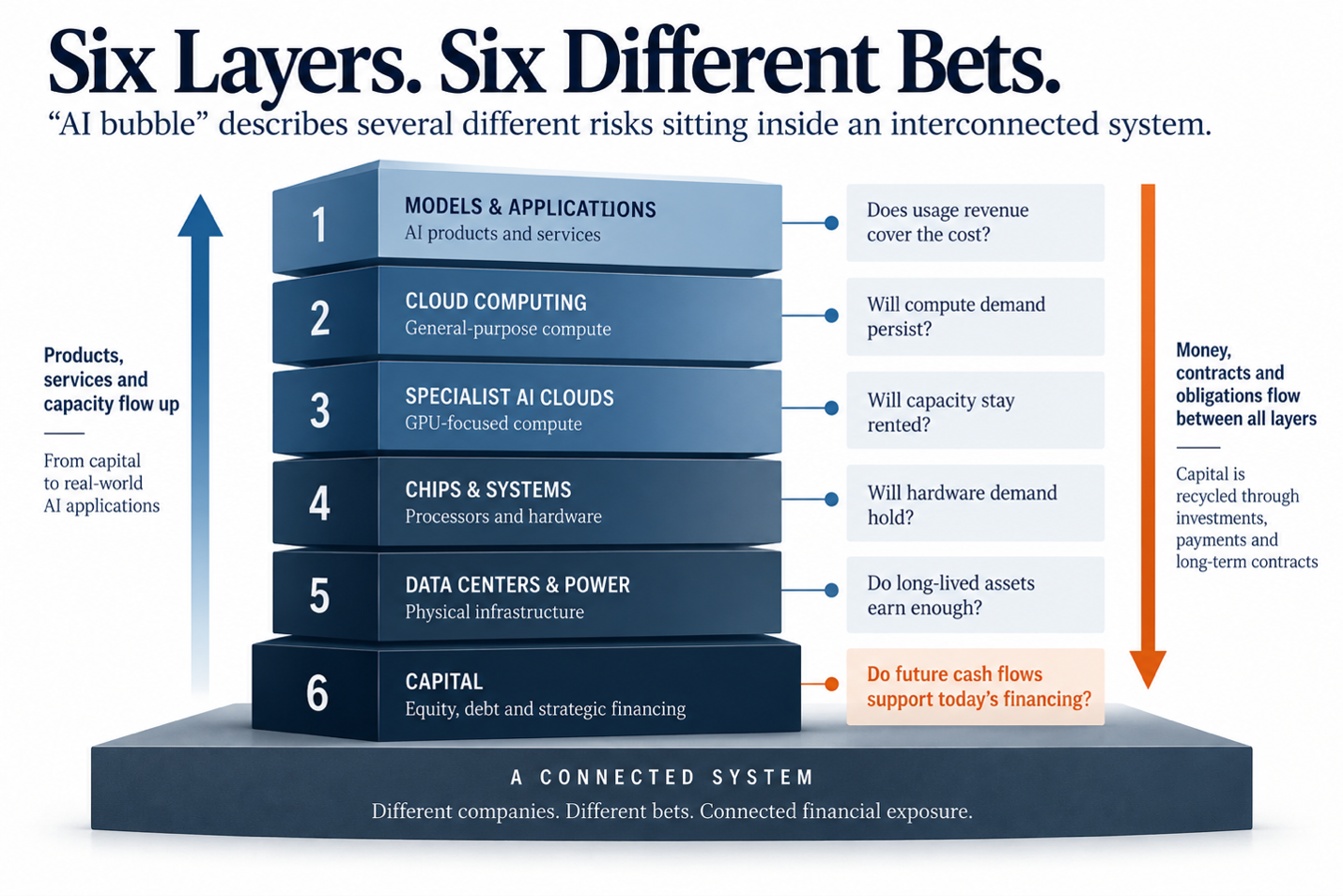
Six connected layers with different sources of income, obligations and exposure.
When the supplier is also an investor
Microsoft, Amazon, Google, and Nvidia can benefit from the commercial spending of companies in which they have a financial interest. A transaction described as a partnership may contain several exposures, each with its own conditions and timetable.
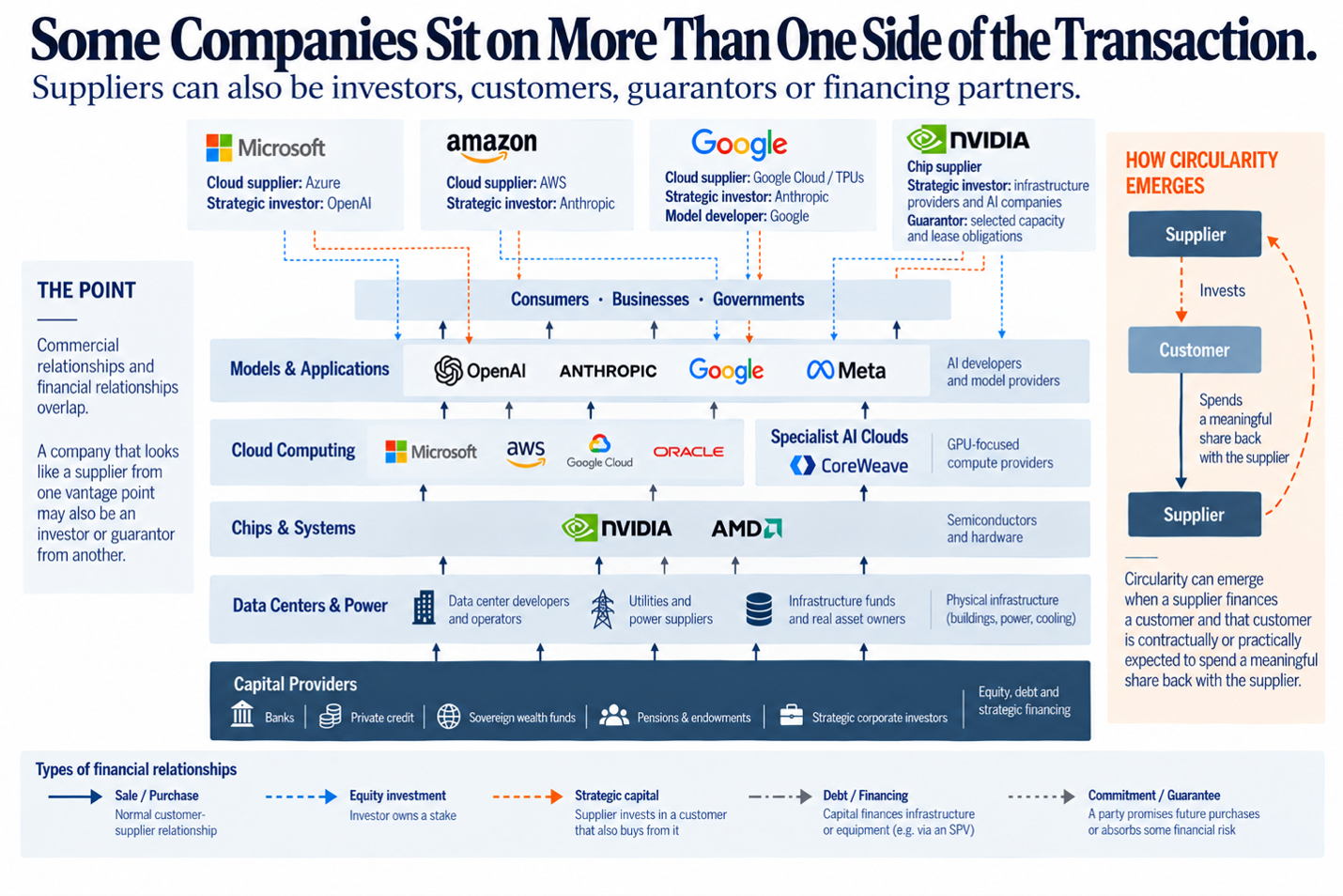
Selected commercial and financing relationships. A company can occupy several roles; the map is not a complete inventory of transactions.
What each party has promised matters as much as the amount announced. Equity buys ownership and bears business risk; a loan has to be repaid. Vendor credit lets a customer pay its supplier later, while a purchase commitment creates spending obligations under specified terms. A guarantee can require one party to meet another's obligation when contractual conditions are satisfied. An announcement can contain several of these without putting an equivalent amount of cash into anyone's account.
A lender may be relying on a lease, the tenant on a computing contract, and the customer on another financing round. Each agreement can look reasonable on its own. Put them together and the apparent protection may depend on the same project opening on time, the same customer growing, and the same financing market staying available. That is a lot of cooperation to ask of the future.
A familiar company name on the diagram reassures me only when its obligations support the exposure being taken. I want to know what it has promised and what resources it can draw on when the plan slips.
One pattern. Three versions.
OpenAI: the same names on both sides
Microsoft helps finance OpenAI and sells it the computing needed to operate. Its disclosures identify $13.0 billion committed and $11.9 billion funded, with approximately 25% ownership on an as-converted basis on June 30, 2026. OpenAI's incremental $250 billion Azure commitment gives Microsoft years of prospective business alongside its ownership stake. Both interests depend on the same customer's success.[2]
OpenAI's reported audited 2025 statements put that dependence in perspective: $13.07 billion of revenue against $17.2 billion of expense to Microsoft alone. Expense is not necessarily cash paid. But when expense to one supplier exceeds total annual revenue, sales growth alone cannot tell us how the business will carry its obligations.[3]
Nvidia's $30 billion equity participation announced in February 2026 adds another supplier with an ownership interest. That investment is distinct from its earlier intent to invest up to $100 billion.[4]
Other agreements support the capacity around OpenAI. Its CoreWeave contracts carried aggregate ceilings of up to $22.4 billion. Nvidia separately agreed to conditional purchases of residual capacity from CoreWeave, giving the provider a potential buyer for capacity left available under those terms.[5]
The reported Ohio arrangement adds a contingent guarantee for lease and power obligations, with a minimum or residual-value term. Owning shares, buying capacity, and guaranteeing an obligation put money at risk in different ways. The contract determines when support is owed.[6]
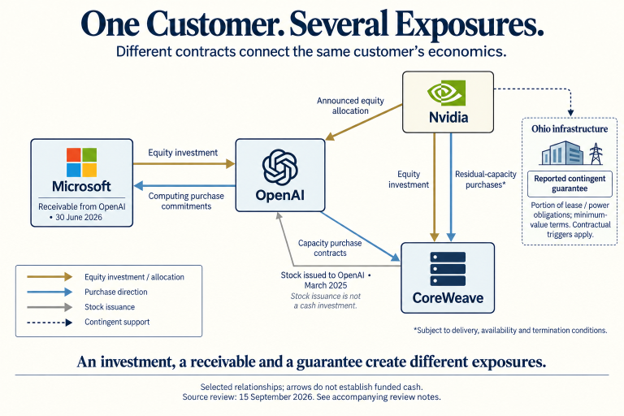
Selected disclosed and reported relationships. Investments, purchase obligations, and contingent support are distinct exposures, not cash amounts to add together. Ohio guarantee terms are reported; capacity purchases are conditional. Neither arrangement is simply vendor lending. Microsoft's FY2026 OpenAI-related revenue and OpenAI's calendar-2025 Microsoft expense cover different periods and are not directly comparable.[7]
A supplier providing more support can protect an investment and preserve a customer at the same time. That helps explain the willingness to provide it. The difficult moment comes when the customer needs more money just as the supplier's expected sales weaken. Supporting the relationship then requires resources the supplier could use elsewhere.
Anthropic: follow the hardware
Anthropic's relationships reach across Amazon, Google, Microsoft, Nvidia, and AMD. Private capital can enter this network through the equipment Anthropic uses, without buying a share of the lab.
Apollo's June 2026 announcement confirmed an initial $35 billion financing tranche with Blackstone supporting Anthropic's capacity expansion. Reporting describes a separate vehicle that borrows to acquire Google TPUs, specialized processors leased to Anthropic and hosted by Fluidstack. Broadcom's reported residual-value guarantees concern $30 billion of debt tranches. They address the equipment's value at the relevant point in the contract, rather than promising to cover every lease payment.[8]
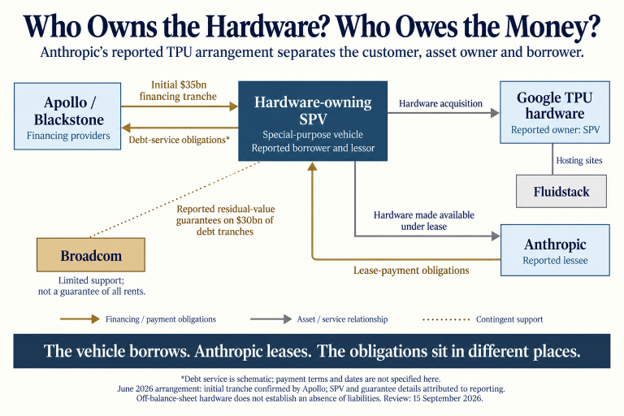
The initial financing tranche is company-confirmed. Detailed vehicle, lease, and guarantee arrangements reflect reporting.[9]
The hardware owner still needs Anthropic's lease payments to service its debt. If those receipts disappoint, the equipment's value becomes more consequential to the financing. Keeping hardware off Anthropic's balance sheet does not establish that the company has no lease liabilities or other obligations.
The financier owns a claim tied to equipment, but its expected payments depend on Anthropic's business. The exposure follows the payments, even when the ownership chart suggests otherwise.
Stargate: look underneath the announcement
Stargate was announced in January 2025 as a new company with SoftBank, OpenAI, Oracle, and MGX as initial equity funders. It described $100 billion to be deployed immediately and an intention to invest up to $500 billion over four years in U.S. AI infrastructure. SoftBank took financial responsibility and OpenAI operational responsibility. The announcement did not establish how much each participant had paid into the entity.[10]
The money that can be traced leads through SoftBank's investments in OpenAI, investments in SB Energy, and developers and lenders financing facilities against expected lease payments. SB Energy, a SoftBank Group company, develops data-center campuses and associated energy infrastructure. OpenAI and SoftBank separately announced $500 million investments in it in January 2026. Those are SB Energy investments, not evidence of cash paid into Stargate itself.[11]
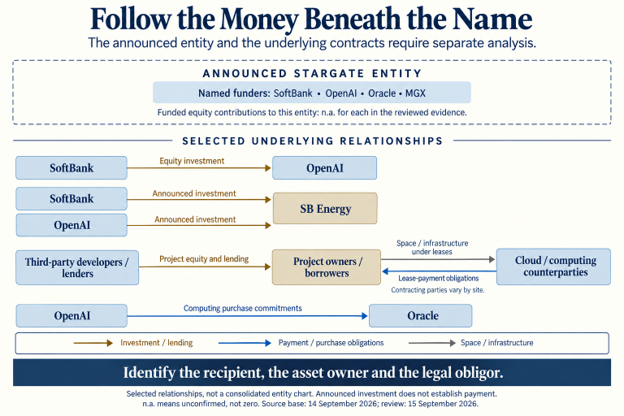
Underlying transactions are shown separately from the announced Stargate entity. Funded contributions to that entity remain unconfirmed.[12]
A headline investment target cannot tell a lender who will make the next payment. Underneath Stargate, a developer may borrow against a tenant's payments while that tenant relies on a separate computing customer. The lender needs the identity of the borrower, the promises in those contracts, and the resources available if receipts arrive late.
For a developer committing money now, the difference is practical. An investment announced elsewhere in the network does not establish that cash is available to meet this project's next obligation. The project can run short while the headline target remains unchanged.
The FTC examined investment-linked spending commitments and potential switching costs in its January 2025 staff report on major cloud-provider partnerships with AI developers. Those conditions help explain why the agreements need to be read together. The report does not quantify the circular share of AI-lab revenue or predict that the partnerships will fail.[13]
Electricity has to arrive on the same schedule
A project can have a completed building, installed servers, and customers ready to buy, yet still lack reliable electricity at the price and date its financing assumes. The facility cannot earn the expected revenue while it waits for its power connection.
In April 2026, the International Energy Agency reported tightening supply chains for gas turbines and transformers, alongside pressure on planning systems, grid connections, and approvals. Electricity available in another region, or generating capacity expected several years later, may not help a facility with an earlier delivery obligation.[14]
Construction and equipment spending have already begun. Depending on the contracts, interest and other carrying costs can continue while operating revenue is postponed. Equipment ages during the wait, leaving less time to earn its expected return. Someone must fund that interval, negotiate a revised schedule, or provide additional support.
Demand does not accelerate a grid connection. A customer still wants the service, but the delay consumes cash and can leave the project late on payments another company was counting on.
The scale changes who is exposed
Moody's July estimate put 2026 capital spending by Amazon, Alphabet, Meta, Microsoft, Oracle, and CoreWeave at $785 billion, rising to around $1 trillion in 2027. These are forecasts, not actual spending. They show how much capital the companies expect to commit before the full return is known.[15],[16]
Morgan Stanley Research estimated roughly $2.9 trillion in global data-center capital expenditure over 2025–2028. About $1.5 trillion would need financing beyond large cloud providers' cash flow. These are projected needs, not signed and funded commitments. A substantial share of the buildout therefore depends on other lenders and investors continuing to supply capital.[17],[18]
That brings private credit, infrastructure funds, and institutions managing retirement assets into the financing through loans, funds, and project investments. A pension fund can own part of the payment chain even when it owns no AI-lab shares. A business can depend on the same buildout through a capacity commitment embedded in its operating plan.
The IMF, Bank of England, and BIS have examined circular financing and borrowing on and off corporate balance sheets. Their work directs attention beyond the size of an individual company's investment to the connections through which financing pressure can spread.[19]
There is a credible case for the spending to earn its keep. Fitch's March assessment estimated AI service revenue of $800 billion to $1.4 trillion by 2030 could help justify investment, subject in part to pricing power. Growing usage must translate into revenue and margins that support the assets built to serve it. If customers capture more of the benefit through lower prices, the financing has less cash to work with.[20]
Paying customers can still leave a funding gap
OpenAI's revenue and Microsoft expense cannot tell us how much of its sales depends on partner funding; that requires tracing the money behind customer purchases. But entirely independent customers would leave another question unanswered: how much outside capital does the business need before it can carry its own obligations?
Revenue must cover the cost of earning it before the remainder can fund expansion. Bain's 2025 analysis estimated that projected computing demand could require approximately $2 trillion of annual revenue by 2030, leaving an $800 billion shortfall against its revenue scenario. That is a modeled future requirement, not a cash deficit measured today. It makes the investment case's dependence on future business explicit.[21]
The assets and agreements also run on different schedules. A building and the chips inside it have different useful lives; customer receipts and loan repayments can arrive at different times. Even a growing business may need several rounds of financing before it produces the cash expected from it. Each round exposes the plan to the price and availability of new capital.
This is where I return to the borrower. Industry forecasts cannot tell me whether this borrower can pay its next installment. Cash on hand, operating cash flow, and financing it can actually draw have to cover obligations as they fall due. A lower price or a delayed opening matters more when the borrower needs new money at the same time.
We have seen this pattern before
During the merchant-power boom, developers planned nearly 380,000 megawatts of new generating capacity against an existing base of roughly 750,000 megawatts, according to contemporary trade reporting. These were plans, not completed plants. They show how much future business the industry was preparing to serve.[22]
The construction boom left excess generating capacity and pressure on generator economics, as FERC described in its review of 2004 electricity markets. Local constraints persisted despite the national surplus. Nobody had to stop needing electricity for a generator to struggle to earn enough where its plant was located.[23]
The contraction reached equipment suppliers. GE's Power Systems orders fell from $24.5 billion in 2001 to $14.2 billion in 2002, while backlog declined from $28.9 billion to $16.7 billion on the 2002 report's basis. Customers were pulling back on the equipment needed for the expected expansion. NRG, PG&E National Energy Group, and Mirant entered bankruptcy in 2003.[24],[25]
The lesson is how a failed investment assumption travels: from the economics of a plant to the equipment orders and financing around it. AI need not repeat merchant power's capital structure or outcome for that to matter. Today's power constraints can put pressure on a project before it opens, even when customers are waiting for the capacity.
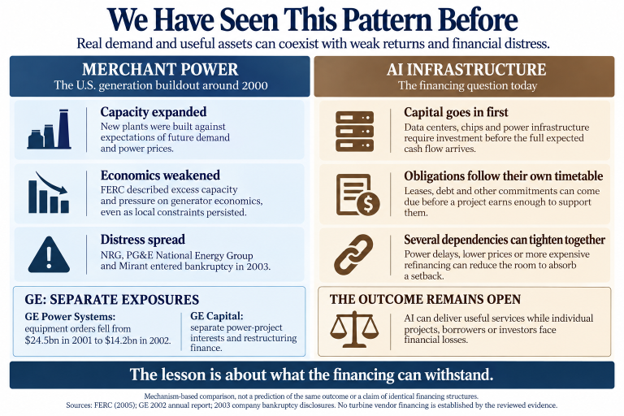
Illustrative comparison of financing mechanisms, not identical capital structures or a prediction of AI’s outcome.[26]
How long can the financing wait?
An Amazon-like success belongs among the possibilities, along with acquisitions, recapitalizations, and changes in ownership. An AI lab could keep serving customers inside a larger company while its original investors, lenders, and counterparties accept different terms. The continued availability of the service would tell us little about what those parties recovered.
Patient equity, available cash, and contractual flexibility give companies different amounts of time to develop the business. A borrower approaching a payment it cannot fund has fewer choices. They may be making the same bet on future demand, but they do not have the same amount of time to be right.
What concerns me is how several manageable disappointments can combine. A late power connection may be affordable with enough cash, and a lower renewal price may leave an adequate margin. Add more expensive refinancing at the same time and the borrower has less room than any one assumption suggested. Its partners may be asked to cover several shortfalls while funding their own plans.
Before relying on this buildout, I would bring three questions to the investment discussion or board meeting. Whose payments ultimately support the exposure? What cash is available if those payments arrive late? What support is contractually owed, and what depends on someone choosing to provide more money? The answers determine how much delay the financing can absorb and who carries the cost while the business catches up.
The companies involved also retain different rights to change their plans. Part 2 examines what happens when they exercise those rights, and how one company's decision changes the economics for the investors, suppliers, and customers around it.
To discuss what the financing behind the AI buildout means for your business, portfolio, or board, reach me at tamika@tamikatyson.com.
Source Notes
Financial figures retain the dates, scope, and attribution stated in the text. The links below provide supporting evidence in this article. The reviewed research did not identify a published study quantifying the circular share of AI lab revenue. Private financial statements cited through reporting retain that attribution.
[1] Amazon, original 1997 letter to shareholders Source
[2] Microsoft FY2026 Form 10-K Source
Microsoft, next chapter of the OpenAI partnership, 28 October 2025 Source
[3] Where’s Your Ed At, reported OpenAI audited statements Source
[4] OpenAI, financing announcement, 27 February 2026 Source
[5] Reuters, CoreWeave expands OpenAI agreement, 25 September 2025 Source
Reuters, Nvidia residual-capacity agreement with CoreWeave, 15 September 2025 Source
[6] Reuters, Nvidia and SB Energy Ohio support, 17 August 2026 Source
[7] Microsoft FY2026 Form 10-K Source
Microsoft, next chapter of the OpenAI partnership, 28 October 2025 Source
OpenAI, financing announcement, 27 February 2026 Source
Reuters, CoreWeave expands OpenAI agreement, 25 September 2025 Source
Reuters, Nvidia residual-capacity agreement with CoreWeave, 15 September 2025 Source
Reuters, Nvidia and SB Energy Ohio support, 17 August 2026 Source
Where’s Your Ed At, reported OpenAI audited statements Source
[8] Apollo, Broadcom, Apollo and Blackstone strategic platform announcement, June 2026 Source
Motley Fool, 17 Jun 2026 Source
Axios via Yahoo Finance, 10 Jun 2026 Source
[9] Apollo, Broadcom, Apollo and Blackstone strategic platform announcement, June 2026 Source
Motley Fool, 17 Jun 2026 Source
Axios via Yahoo Finance, 10 Jun 2026 Source
[10] SoftBank Group, 22 Jan 2025 Source
[11] SoftBank Group, 27 Feb 2026 Source
DataCenterDynamics, Crusoe secures $11.6bn for Abilene Source
CoStar, first Stargate project lands a $7.1bn construction loan Source
Data Center Knowledge, 22 Dec 2025 Source
Related Digital, 24 Apr 2026 Source
SoftBank, first follow-on tranche, 1 April 2026 Source
SoftBank, second follow-on tranche, 1 July 2026 Source
OpenAI, Stargate partnership with SB Energy, 9 January 2026 Source
[12] SoftBank Group, 22 Jan 2025 Source
SoftBank Group, 27 Feb 2026 Source
DataCenterDynamics, Crusoe secures $11.6bn for Abilene Source
CoStar, first Stargate project lands a $7.1bn construction loan Source
Data Center Knowledge, 22 Dec 2025 Source
Related Digital, 24 Apr 2026 Source
SoftBank, first follow-on tranche, 1 April 2026 Source
SoftBank, second follow-on tranche, 1 July 2026 Source
OpenAI, Stargate partnership with SB Energy, 9 January 2026 Source
[13] FTC, January 2025 staff report on AI partnerships and investments Source
[14] IEA, energy and AI update, 16 April 2026 Source
[15] Scope comparison: early-2026 guidance put combined capital spending by Amazon, Alphabet, Meta, and Microsoft near $700 billion. Moody's July estimate includes Oracle and CoreWeave and uses a later forecast date. The figures are not cumulative totals. CNBC, combined 2026 guidance, 6 February 2026 Source
Moody’s via CNBC, 24 July 2026 Source
[16] Additional scale comparison: Amazon's $220 billion global, companywide capital-spending plan is roughly one-third of the amount all U.S. state and local governments combined spent on capital projects in 2025. Amazon's plan covers its entire business, not just AI; the comparison is illustrative and uses different geographic and reporting scopes. Reuters, July 30, 2026 , Amazon raises its capital-spending forecast to $220 billion Source
Federal Reserve data via FRED , State and Local Governments: Total Capital Expenditures Source
[17] Within its approximately $2.9 trillion global data-center estimate for 2025–2028, Morgan Stanley identified approximately $2.5 trillion associated with AI and separately more than $300 billion of power-infrastructure investment. These estimates have distinct scopes. Morgan Stanley Research, Bridging the Data Center Gap Source
[18] Within the projected funding mix, Morgan Stanley envisaged more than $800 billion from private credit, about $200 billion of investment-grade corporate debt, and roughly $150 billion of asset-backed and mortgage-backed securities. These are projected financing sources, not committed or funded amounts. Morgan Stanley Research, Bridging the Data Center Gap Source
[19] Publication dates and scope: the IMF's April 2026 financial-stability report discussed circular financing; the Bank of England's July report examined potential fragility in off-balance-sheet structures; BIS's March analysis considered borrowing on and off corporate balance sheets. IMF, April 2026 Global Financial Stability Report, chapter 1 Source
Bank of England, July 2026 Financial Stability Report Source
BIS, March 2026 analysis of on- and off-balance-sheet borrowing Source
[20] Other assessments: Moody's July analysis identified about $460 billion of direct hyperscaler debt and roughly $1.2 trillion of lease commitments, including more than $820 billion for leases that had not commenced. S&P highlighted rising capital needs and financing complexity. These assessments and Fitch's revenue scenario cover different measures and should not be combined into a single funding total. Moody’s via CNBC, 24 July 2026 Source
S&P via Axios, 11 September 2026 Source
Fitch, 24 March 2026 Source
[21] Bain, September 2025 revenue-requirement scenario Source
[22] Public Utilities Fortnightly, Gas Turbinemania, June 2002 Source
[23] FERC, State of the Markets 2004, printed pp. 59–60 and 115 Source
[24] Additional equipment-business detail: GE's subsequent annual report recorded customer termination fees, net of associated costs, of $0.9 billion in 2002 and $0.6 billion in 2003. GE 2002 Form 10-K, annual-report pp. 54–55 Source
GE 2003 annual report, Exhibit 13, p. 53 Source
NRG, SEC-filed bankruptcy announcement, 14 May 2003 Source
PG&E, SEC-filed 2003 release Source
Mirant, 2003 Form 10-K Source
Chris Ireland, NYU Stern, April 2005, introduction and Appendix B Source
[25] GE Capital's financial exposure was separate from GE Power Systems' equipment business. It included power-project interests and restructuring finance. NRG's bankruptcy announcement included a $250 million debtor-in-possession commitment from GE Capital. This was financing during a restructuring; the transactions do not establish that GE or Siemens financed the original turbine purchases. NRG, SEC-filed bankruptcy announcement, 14 May 2003 Source
Calpine 2003 Form 10-K, King City transaction Source
[26] FERC, State of the Markets 2004, printed pp. 59–60 and 115 Source
GE 2002 Form 10-K, annual-report pp. 54–55 Source
NRG, SEC-filed bankruptcy announcement, 14 May 2003 Source
PG&E, SEC-filed 2003 release Source
Mirant, 2003 Form 10-K Source
Chris Ireland, NYU Stern, April 2005, introduction and Appendix B Source
Calpine 2003 Form 10-K, King City transaction Source