
Part 5: Every Assumption Makes Sense. Until You Put Them Together.
Financing the Meantime | Part 5 of 5
Tamika Tyson, Founder and Managing Partner, SCALE | September 2026
When things are going well, no one has time to meet with the risk officer. When things start to decline, everyone wants to know how soon you are available. The questions you asked three months ago are now urgent; the meeting you could not get is now mandatory. Someone also wants to know why risk didn't raise this sooner.
Imagine you're the risk officer assessing a new AI investment. The technology works, and the commercial team recognizes demand. Expansion requires equipment, power, and capital, all invested years in advance. Meanwhile, competitors are moving forward, and the business seeks a decision. At the same time, the Federal Reserve is publishing its outlook for rates and inflation. Its projections are conditional, not promises. An election lies ahead. The company is considering a long-term investment while the cost of capital, its customers’ purchasing power, and the policy environment remain unsettled.
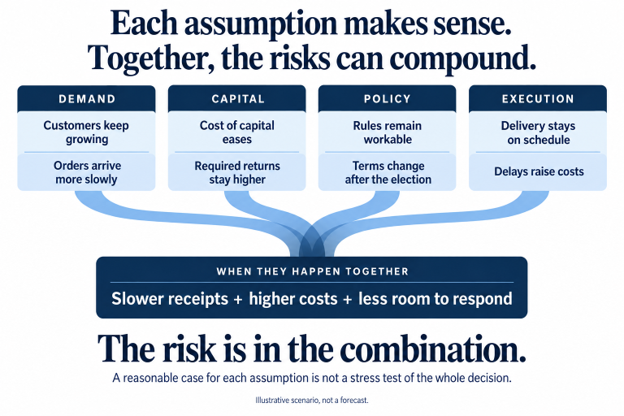
This is where the credit, investment, and political cycles meet inside one decision. Investment enthusiasm creates pressure to build. Credit conditions determine how readily the money can be raised or replaced. Political decisions can change the economics after the commitment is made. Those cycles do not move in lockstep.
The risk officer has to assess how this opportunity holds up across them. If inflation proves persistent, what happens to construction costs and customer budgets? If borrowing costs stay elevated, can the customer still finance its commitment? If policy changes after the election, which assumptions about equipment access, power, or project economics need to be revisited? A lower policy rate would not, by itself, guarantee this borrower cheaper or more available credit.
The investment committee would still like an answer by Thursday.
Then there are the relationships within the deal. Is the customer in the revenue forecast the same company receiving the investment? Do its payments depend on another funding round? Does the proposed return depend on demand growing, credit remaining available, and policy staying favorable at the same time?
Everyone in that meeting has a job to do. The commercial team needs to secure the customer. The technology team needs capacity before demand arrives. Finance has to make the commitments affordable. Management has to weigh the cost of waiting against the cost of being wrong.
Their confidence may reflect genuine expertise. Their urgency may be justified. A risk officer who overlooks either will struggle to make a useful recommendation. The future will not be settled before the approval is due.
“So, are you recommending we don't do it?”
That question compresses a complicated job into two answers most likely to get someone into trouble.
Say yes to the investment, and the risk officer may later be asked why it was allowed. Say no, and the business may spend the next year calculating exactly how much money the company could have made. Recommend proceeding with conditions, and someone has to negotiate, fund, and live with them.
During the last downturn, I often found myself saying, “This risk was highlighted in a previous deck.”
Only once did I remind someone that the thing they had told me would never happen had, in fact, happened.
Apparently, “never” had an expiration date.
There is very little satisfaction in that conversation. By then, the question is what we can still do, how much it will cost, and which options remain. The earlier deck matters because it shows what we knew when we still had more choices.
I often say there is nothing new under the sun. We keep making the same mistakes with new headlines. That does not mean the opportunity is imaginary. It means an extraordinary opportunity can still be undermined by familiar habits: treating available financing as permanent, letting a successful exception become the rule, and postponing an uncomfortable decision because current results look good.
In Through the Cycle, I explored why changing conditions and better tools still require judgment. The risk officer has to recognize what is familiar without assuming the outcome is inevitable. Experience should sharpen the questions and help us recognize when the answers are better this time.
The opportunity has a sponsor
Return to the AI investment meeting. The proposed expansion serves a customer in which the company also holds an investment. The customer expects to pay for computing with money it is still raising. The company expects those payments to help justify the capacity it is building. Each relationship may have a sound commercial purpose. Together, they raise a question about how much of the plan depends on the customer's next financing.
The customer may become highly profitable. Its investors may have strong reasons to continue funding it. The risk officer still needs to understand what happens between today’s commitment and the hoped-for result. The executive who championed the investment is sitting across the table. The commercial team has spent six months negotiating the contract. The technology team believes the capacity is essential. They have work behind their recommendation. Asking about the dependency can sound like asking whether all three teams have wasted their time.
The risk officer's job is to make the question answerable. How much spending is already funded? What can the customer cancel? What remains payable if delivery slips? Does the strategic partner guarantee this obligation, or does everyone simply feel better because the partner is involved?
Sales has a pipeline. Finance has a forecast. Legal has an agreement with conditions. Treasury has money available if certain conditions are met. All four can be accurate, but they may represent different levels of certainty. The risk officer must help the teams reconcile these answers by identifying shared assumptions, applicable protections, and the company's commitments before all remaining conditions are fulfilled. Do this while the paint is still wet. Inviting the risk officer after price, capacity, and launch dates are locked turns helpful advice into unwanted friction.
Knowing the risk does not settle the decision
Suppose the equipment payments are scheduled, customer receipts arrive later, and management has assumed another financing will bridge the gap. The dates are known. The dependency is documented. The uncertainty concerns whether the money will arrive on acceptable terms and what happens if it does not.
Now the risk officer must turn visibility into a choice. The company could stage the equipment order, negotiate a customer deposit, secure committed liquidity, or accept the exposure because it can afford the gap. Each option changes the economics. The supplier may charge for flexibility. The customer may take its business elsewhere. The additional funding may reduce the return.
Waiting also has a cost. Capacity reserved today may be unavailable later. A competitor may establish the customer relationship first. The risk officer cannot fairly assess the downside while treating the opportunity forgone as imaginary.
“Be prudent” is easy advice to give when someone else has to price it.
Suppose the teams agree to fund a smaller first phase, secure liquidity for the interval before customer receipts, and make the next equipment order conditional on agreed payment milestones. The commercial team preserves the relationship. The technology team revises the deployment schedule. Finance prices the funding. The risk officer tests whether the revised commitment fits what the company can afford.
The investment moves forward, shaped by the work done around the table. It is a win, even if no one later remembers which question saved the deal. The cost of protection is clear today; its value will only ever be measured by the crises that didn't happen. Someone still has to have the courage to recommend paying for it.
The first explanation may be right
A few months later, imagine the first customer payment is delayed. Usage is growing, but the customer requests a change to its payment schedule. The commercial team says this is a temporary cash-management issue. The technology team observes stronger adoption. Finance expects the funding round to close. A delayed payment might reflect administrative friction, a disputed invoice, or a more serious funding problem. Rising usage can support the investment case while revealing little about whether the customer earns enough from that usage to cover its bills. A funding round can provide real runway without eliminating the need for another one later.
The risk officer has to establish what changed and whether the original protections still work. That may mean asking for updated cash information, reviewing the payment terms, and checking how much additional capacity the company has committed since the last approval. It means listening to the commercial explanation and testing it.
The meeting needs a decision before the evidence can offer certainty.
Raise the alarm every time a payment moves and the business will learn to tune it out. Wait until no reasonable explanation remains and the cheapest options may have disappeared. The work happens in that uncomfortable interval: enough evidence to deserve a decision, too little evidence to make it easy.
The risk officer can also be wrong. The invoice may be paid the following week. The financing may close on better terms than expected. Customers may begin paying at attractive margins. Those developments should change the assessment. A function that never becomes more comfortable gives the business little reason to distinguish its analysis from a permanent objection.
In Stress Test, I examined why a clear warning and a written response can still fail to produce action. Here, the challenge is to decide what the new evidence changes before the next commitment is made. Even obtaining the evidence is work. In its 2008 report on subprime losses, UBS described reporting that could be complex, outdated, or aimed at the wrong audience, alongside weaknesses in combined exposure analysis and independent challenge.[1] The institution had reports. It did not consistently turn them into an effective understanding of the risk.
The comparison matters because the risk function was part of that failure. The useful question for our AI meeting is what could remain unclear even if every scheduled report arrived on time. The risk officer has to challenge the business's assumptions and the adequacy of the risk team's own work.
Every exception has a reason
Now imagine the company grants a short payment extension. There is a reasonable explanation, and the customer relationship is valuable. Next quarter, it increases the customer’s limit to accommodate growth. Later, it approves the next equipment order before the agreed payment milestone because waiting would disrupt the expansion. No single decision looks like a reinvention of the original investment. Together, they may have produced one.
The first delay attracts attention. The second becomes a revised forecast. By the third, the revised forecast is the baseline against which everyone reports progress. The risk officer has to preserve the comparison everyone else has moved past. How much cash was expected at the original approval? How much has arrived? How much more has been committed? Have the customer, timetable, and protections changed enough that the company is effectively making a new investment decision?
The expansion may deserve approval. It deserves to be judged as the position it has become, including the protections the company has given up along the way. By then, the exception has acquired colleagues and become the business model. This helps explain why the same mistakes recur. A successful exception becomes evidence that the original limit was unnecessarily conservative. If the customer pays and the project works, the protection that was waived begins to look like bureaucracy. The organization remembers the return. It never observes the alternative outcome in which the missing protection mattered.
There are rewards for repeating the decision. A completed transaction has a closing date, a revenue contribution, and a place in the performance review. A loss avoided requires an argument about something that did not happen.
I once asked a CFO, “How much can we lose without anyone getting fired?”
“Zero.”
“Then we should not do any deals.”
The exchange gets at a difficult question: how much risk are we actually willing to take, and how will we judge the decision if it goes against us? If a loss automatically means someone made a bad decision, people have a reason to favor choices they can defend afterward. A respected sponsor, a familiar name, or competitors making the same investment can make a choice easier to explain. Those may also be sound reasons for confidence. They do not settle whether the terms fit our business.
A good decision can lose money. A poor decision can make money. Judge only the result, and we risk punishing sound judgment and promoting good luck. If the risk officer recommends a cash reserve and the market keeps improving, everyone can calculate what that reserve might have earned elsewhere. Nobody can send an invoice for the crisis it would have helped the company survive.
Risk officers face their own incentives. Recommending caution can feel safer than supporting an uncertain investment. They may also defend an earlier approval or protect a favored model. Everyone has a position that feels safer professionally. The work is to establish what makes sense for the business. We repeat mistakes when the conditions that made them attractive survive the lesson. The policy manual remembers the last crisis, but the operating model remembers the path of least resistance.
The AI is new. The meeting is familiar.
We began this series by giving AI room to succeed. The technology can become more useful, customers can keep buying, and investments that look excessive today may eventually prove worthwhile. But the money committed along the way has its own timetable. Success arriving later does not necessarily protect the people financing it now.
We followed what happens when plans change but commitments remain, why the same opportunity produces different outcomes for different investors, and how those exposures reach portfolios we already own. The participation contract brought us to the operating relationships underneath those returns: why employees, customers, and suppliers stay, and what financing is needed when their terms change at different times.
Now we arrive at the decision behind all of it: how much can we commit today, and what happens if the opportunity takes longer to deliver than our financing allows?
So, is this an AI bubble, and what happens if it bursts?
I am less convinced that the whole thing ends with one dramatic pop. I think the air can leave the balloon.
Customers can keep using AI while growth falls short of what investors paid for. Capacity can take longer to earn its return. Financing can become more expensive. Valuations can decline, projects can be postponed, and the next round of capital can arrive on terms the original investors would rather not accept. Some businesses may fail even as the technology becomes more useful.
That would not require the AI opportunity to disappear. It would require expectations to come back toward what the businesses can deliver, at a pace their financing allows.
I remain optimistic about AI’s long-term value. I just hope your investment horizon is not short.
And by horizon, I mean more than how long you intend to hold. A lender has a repayment date. A supplier has payroll. A fund may face withdrawals. A company may need another financing before its customers generate enough cash. Believing in the long run does not move those dates.
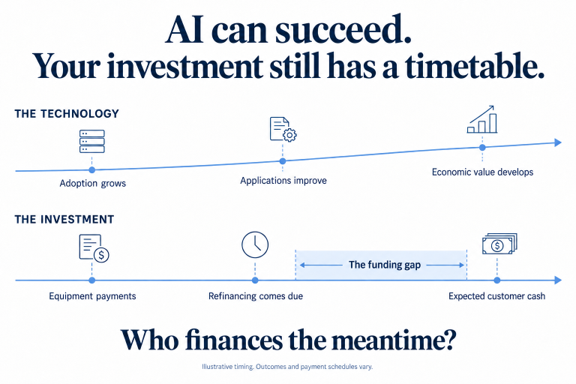
Even investors who can wait need to ask what they will own at the end of the wait. The technology can succeed after the original shareholders have been diluted, the debt has been restructured, or the assets have changed hands. The eventual success can belong to someone who bought later, at a different price.
That is why the meeting is familiar. Capable people see a real opportunity. Each has a job to do and reasonable grounds for wanting to proceed. The risk officer has to help the room distinguish confidence in the technology from confidence that this investment, on these terms, can survive the wait.
The credit, investment, and political cycles explored in Through the Cycle will keep moving after the approval. The question is how much room our commitments leave us when they turn. The risk officer does not have to predict the day the air starts leaving the balloon. The job is to help the business decide how much it can commit, what protection is worth paying for, and what would cause it to change course.
The AI may work out beautifully in the long run.
We still have to finance the meantime.
To discuss how these dependencies affect your business, portfolio, or board, and how SCALE can help assess them, reach me at tamika@tamikatyson.com.
Source notes
[1] UBS, Shareholder Report on UBS's Write-Downs, April 18, 2008, sections 6.3.6.1–6.3.6.4, printed pp. 38–40. UBS's retrospective account identifies shortcomings in measurement, reporting, independent analysis, and challenge. Used as an organizational comparison, not a claim that AI financing reproduces the subprime crisis. Source
Double-click to edit...