
The Circle Becomes a Spiral
What happens when AI's interconnected financing meets a change in the assumptions?
Financing the Meantime | Bonus Article
Tamika Tyson, Founder and Managing Partner, SCALE | September 2026
This morning, I took a walk around a 3-mile loop. Walking in a circle means you eventually end up where you started. But if the circle itself is moving, knowing you're circling isn't enough; you also need to understand where it's leading you. And what if it's not a circle but a spiral? A shape that passes the same points repeatedly, just at different scales. That thought came to mind when I considered AI financing.
Part 1 began with essentially this problem: the revenue can be real across the AI buildout while several agreements ultimately depend on the same future cash flow. [1] Each transaction can serve a valid commercial purpose. All assets can be genuine, and each participant might have a logical motive for participating. Still, money can circulate among the same participants. That activity can finance the buildout without yet proving that customer cash will sustain it. The main question I was left pondering after finishing the series was somewhat different from the one I had initially.
What happens when enough of the financing depends on other participants in the same circle?
A circle is not necessarily a problem
The term 'circularity' can seem uncomfortable in finance because it might suggest that transactions are artificially created. That’s not what I mean here. An equity investment isn't equivalent to a loan, and a guarantee isn't the same as funded debt, even if it leads to a recognized liability or derivative. Similarly, a purchase commitment isn't automatically vendor financing; suppliers can invest in a customer and still earn revenue from product sales. The crucial elements are the contracts involved and the cash flows.
Consider a simple example: an investor funds an AI developer, who then buys computing capacity. The cloud provider uses these payments plus additional financing to develop infrastructure. The infrastructure provider buys chips, and the chip company receives cash.
Now, imagine the chip company invests some cash into the AI ecosystem, provides a guarantee that enables additional infrastructure finance, or agrees under certain conditions to purchase capacity. Some of the money starts moving back toward the customer. This doesn't invalidate the original sale; it simply shifts the underlying question I want to address.
Where did the money ultimately come from?
Consumers who pay for subscriptions are considered outside cash flows. Similarly, businesses paying for AI services from their operating budgets are outside cash, as are governments purchasing AI services. However, an AI company raising another round of financing and using those funds to buy more compute is different. While the purchase may be legitimate, the system still requires someone outside the financing chain to ultimately generate the economic return. This raises a question I wish we could answer more precisely:
How quickly is outside customer cash replacing inside financing?
THE AI FINANCING CIRCLE
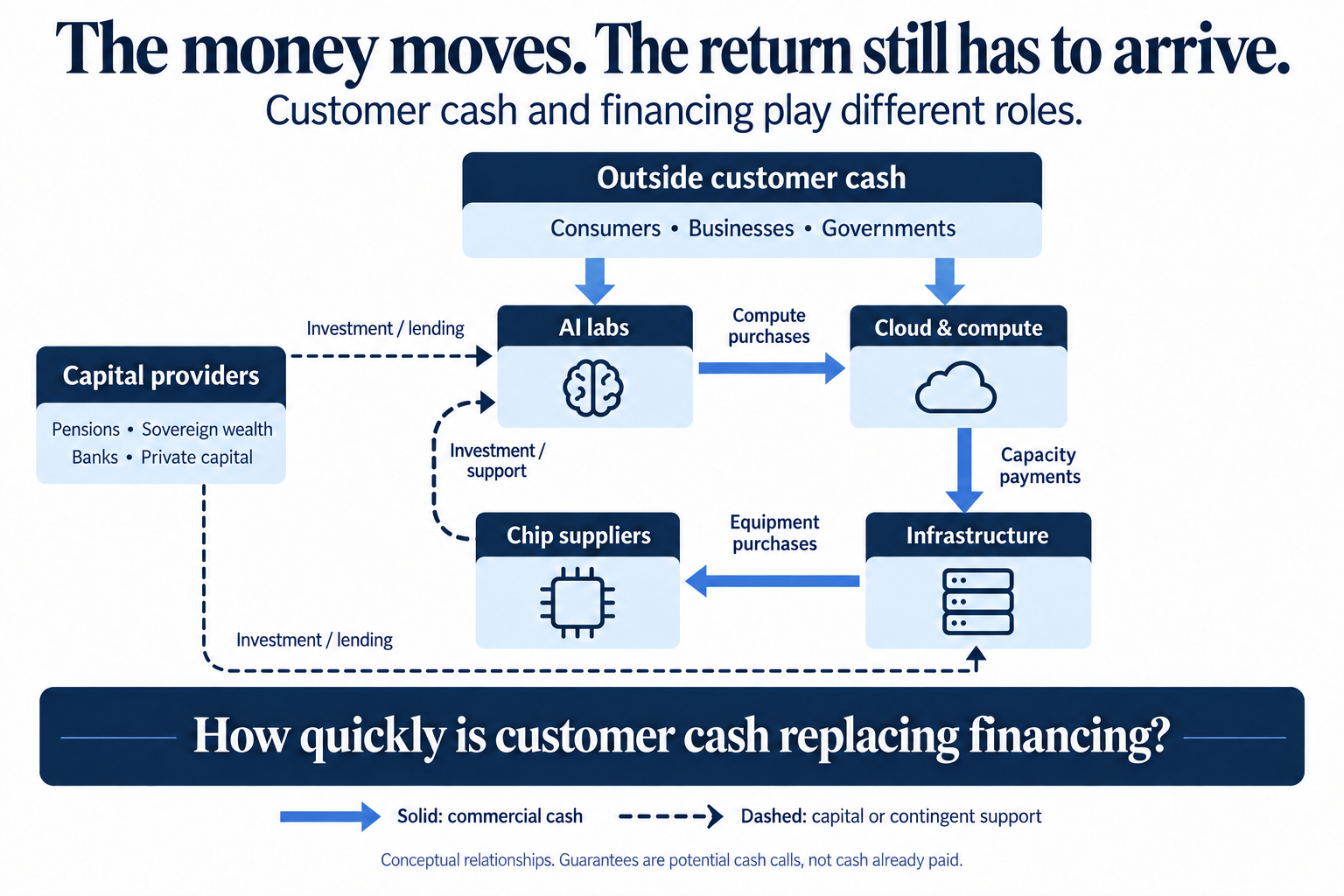
The question is not whether money circulates. It is how much independent cash enters from outside the circle.
When the circle becomes a spiral
A circle depicts relationships, while a spiral illustrates how those relationships can sustain the same problems. Visualize the optimistic cycle: as AI usage grows, customer revenue increases, leading to higher compute utilization. Infrastructure reaches acceptable returns, encouraging lenders to refinance and investors to inject more capital. This results in increased capacity. Over time, customer-generated cash flow can replace some external capital needs, making the cycle less dependent on external financing.
Now, imagine tweaking some assumptions: customer adoption continues, but monetization lags behind expectations. The AI company needs another funding round. The lender provides capital again, but at a higher expected return. Meanwhile, the infrastructure provider finds it takes longer to realize expected returns. This decreases perceived value, lowers asset values, and reduces borrowing capacity. A strategic partner may be asked to step up, increasing its exposure. While none of these issues cause immediate failure, a series of small setbacks can compound, creating broader challenges. The circle represents these interconnected relationships.
The spiral begins when those connections transmit the same problem.
There is nothing new under the sun
I said in Part 5 that there is nothing new under the sun. We keep making the same mistakes with new headlines. That does not make the opportunity imaginary. It means extraordinary opportunities can still be undermined by familiar financing habits. [2] There is another familiar feature in these cycles: value.
Value is ultimately about perception, yours and mine. Finance professionals have engineered some remarkable structures, but those structures become economically meaningful only when at least two parties are willing to recognize and transact on that value, even if they disagree on its true worth.
They do not need shared belief. They only need to agree that it is worth transacting.
That distinction is crucial during an infrastructure boom. A lender doesn't need to agree with an equity investor on the asset's valuation; they only need to trust that collateral, contracts, cash flows, or guarantees justify the amount they are willing to lend. For example, a buyer might value an asset at $100, but a lender may be comfortable lending only $60 against it. Both can be involved without sharing the same valuation.
The issue arises when a subsequent transaction requires someone else to acknowledge that value, and nobody does. For instance, refinancing depends on an existing or new lender providing funds; a residual-value guarantee can require the guarantor to cover a future shortfall in asset value, subject to the contract’s terms; an equity round depends on another investor recognizing the potential; and a lease assumes the asset will remain useful enough for others to pay for it. When valuation recognition shifts, the physical asset remains, but the associated financing capacity can vanish.[3]
We have seen that before.
NOTHING NEW UNDER THE SUN
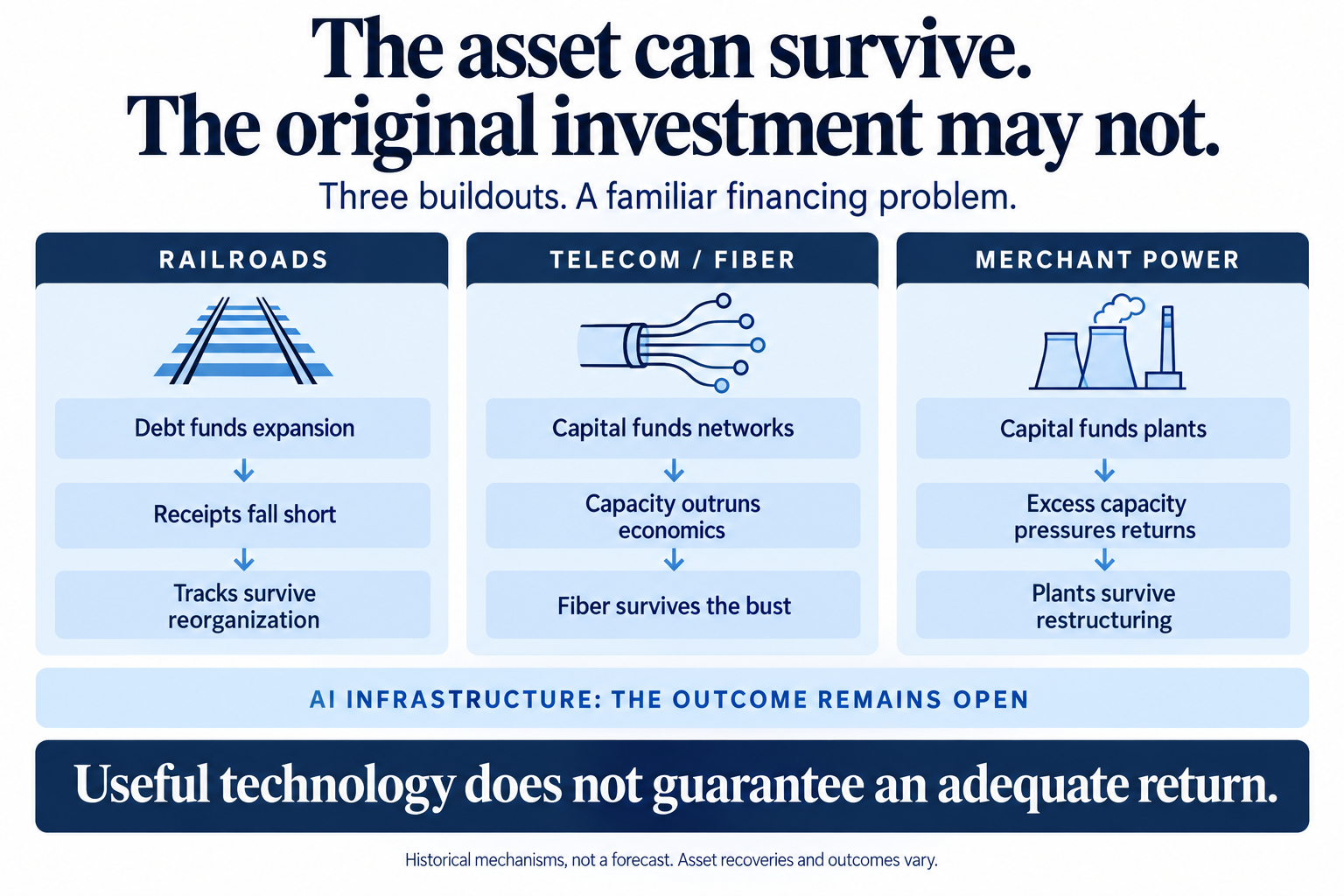
Useful technology does not guarantee that the original financing earns its expected return.
Telecom: the technology can be right and the capital structure wrong
The telecom and fiber buildout around the turn of the century is difficult to ignore.
Telecommunications companies required extensive equipment and infrastructure even before demand materialized. Equipment suppliers had strong incentives to assist customers with financing. Customers focused on building networks, suppliers recorded sales, and investors provided funding for expansion.[4]
As expectations weakened and financing conditions tightened, capital became more difficult to acquire. Infrastructure had expanded more quickly than economic support could sustain. Companies went bankrupt, and investors faced losses. Despite these setbacks, internet usage persisted. This is crucial because the internet wasn't invalidated by the telecom bust, and fiber technology remained valuable. In fact, the long-term demand for data continued to grow over the following decades.[5]
The timing and capital structures were important parts of the problem.
A technology can change the world after destroying some of the capital that financed its first buildout.
Railroads: the asset can survive the owner
Railroads provide an older version of the same lesson.
Railroad construction needed significant capital investment well before the anticipated economic activity could generate enough revenue to cover it. Expansion was financed through debt, and successful lines prompted further construction. Over time, some sections of the system became overbuilt relative to the economic conditions available at the time.
Credit tightened, leading railroads into receivership and reorganization. The tracks remained intact, and trains continued operating. Ownership was transferred during this process.[6]
This distinction is crucial for AI infrastructure. A data center doesn't vanish just because its owner reorganizes. Similarly, a GPU remains physically capable of computing despite the company's refinancing issues, although continued operation requires power, staffing, and funding. Power connections can still hold value even if the initial investment is impaired. Restructuring can wipe out investors without destroying the core technology.
Merchant power: real demand does not guarantee an adequate return
The merchant power boom provides another variation, one already discussed in Part 1.
Developers built substantial generating capacity, anticipating future electricity demand. Over time, this excess capacity strained generator economics, contributing to the financial pressures surrounding several major operators’ bankruptcies. As customers reevaluated their expansion plans, equipment orders declined significantly. [7]
No one stopped needing electricity. However, that alone was not sufficient. A plant also had to generate an adequate return in its location, considering the associated financing. This introduces another important distinction:
Real demand does not guarantee an adequate return on every asset built to serve it.
Follow the cash, not the market capitalization
Market capitalization shows what investors are collectively willing to pay for a company's equity now. It makes an impressive headline. The lease payment still has to clear. A company needs cash, operating cash receipts, obtainable financing, saleable assets, or additional investment from a willing party. Instead of focusing on who is worth the most, I suggest asking: Who is generating cash? Who is consuming it? Who needs refinancing? Who can stop spending? Who cannot? Who has guaranteed someone else's obligation? Who owns sellable assets? And who depends on others to recognize value before the next payment?
The question isn't just how much a company owns or owes. It is what must be paid, when, and which resources will actually be available. Book equity is not a spending account, and adding cash to it does not measure liquidity. Assets may be saleable, but secured creditors may have claims on the proceeds, and selling an asset may also mean giving up its future cash flow. What matters is whether cash on hand, cash generated by the business, and financing or asset sales can cover obligations as they come due.
The contracts determine how much room a company has when assumptions change. A purchase commitment, a lease that has not started, and a guarantee can create very different demands on cash. Some payments can be delayed or avoided; others become due precisely when another participant runs into trouble. I want to know what can be canceled, what triggers payment, and whether separate disclosures describe the same obligation. Following those cash flows and commitments divides the ecosystem into three imperfect but useful groups.
Cash generators
These companies generate significant cash while benefiting from the buildout; their reported companywide cash flows also include other businesses. NVIDIA and Broadcom are clear examples. Another entity raises the funds, commits to the capacity, or constructs the facility. A notable part of that expenditure translates into semiconductor and systems revenue.[8]
Those roles can overlap. NVIDIA can collect cash from equipment sales while investing in customers or supporting infrastructure around them. The question is how much cash it retains after actual payments back into the ecosystem, and what additional obligations could require cash later. A company benefiting from the buildout can also become one of the companies asked to finance its continuation.[9]
Cash recyclers
Microsoft, Amazon, Alphabet, and Meta possess large existing businesses that generate cash flow, while also investing heavily in AI infrastructure. These companies can serve as suppliers, customers, investors, and infrastructure owners simultaneously. Their established operations provide them with options that a dedicated infrastructure vehicle cannot access.[10]
AI returns can also come from an existing business through improved advertising, software retention, logistics, or productivity. However, reporting a separate AI revenue line won't account for all benefits. The key test is whether it generates incremental cash flow after deducting the costs to produce it.
Part 3 made this point in discussing Amazon. The company had substantial operating cash flow even while heavy investment pushed free cash flow negative. Those resources give Amazon options that smaller participants may lack. [11]
Cash absorbers
Other parts of the ecosystem today demand significant capital for growth. Frontier AI creators require computing resources. Specialist AI clouds need infrastructure and hardware. Data-center developers require buildings, power, and equipment, even before customer economics are fully established. None of these factors guarantee investment success; they only indicate who needs funding next. The specific names are less important than the overall flow of cash.
Where I’m watching for financing pressure
Other companies sit at different points in the chain.
I’m going to say the quiet part out loud: CoreWeave, Oracle, IREN, and SoftBank are on my watchlist. I’m not declaring a crisis; I just think they warrant a watchful eye.
At June 30, 2026, CoreWeave reported $35.6 billion of indebtedness. Its $15.6 billion of stated liquidity included about $10.0 billion of availability under financing facilities; cash and marketable securities were approximately $5.5 billion. For the first six months, operating cash flow was positive $3.7 billion, while investing activities used $14.9 billion. Management said existing resources and borrowing availability should cover anticipated obligations for the year following the filing date, while future investment could require substantial additional financing. [12] That's why I recommend monitoring the availability and cost of the next dollar, along with customer performance and collateral values. An interruption in the capital market could be significant even before the underlying technology becomes obsolete.
Oracle presents a different duration problem. At August 31, 2026, it disclosed $288 billion of additional leases, substantially all for data centers, that had not commenced. They were generally expected to begin between fiscal 2027's second quarter and fiscal 2029, with terms of fifteen to nineteen years. It separately disclosed $34.15 billion of unconditional purchase and certain other obligations with terms of at least one year. [13] The estimated $322 billion represents a multiyear commitment total, not an immediate cash payment. The key question is whether customer receipts will be sufficient in volume and timing to cover the payments when they are due.
IREN belongs on the watchlist because it is committing capital while transforming its business. The company is shifting data-center capacity from Bitcoin mining toward AI cloud services, which requires GPUs, supporting infrastructure and successful delivery of computing capacity to customers. Its disclosed capital commitments increased from approximately $369 million to $13.81 billion in the year ended June 30, 2026, with approximately $13.61 billion payable within the following twelve months. That makes timing particularly important: revenue generally begins after capacity has been delivered, commissioned and accepted by the customer. Construction or equipment delays can therefore postpone revenue while spending continues. Management said existing cash, expected operating cash flows and financing proceeds should cover obligations for at least twelve months from the financial statements’ date. I’m watching whether those funding sources and customer receipts arrive on schedule. The issue is whether committed spending, financing and delivery remain aligned as the business expands.[14]
SoftBank belongs on the watchlist because the value of its investments helps support its ability to finance further investment. SoftBank Group is a strategic investment holding company whose portfolio includes a substantial holding in Arm and investments in AI-related businesses. That portfolio gives it financing options, including selling assets or borrowing against eligible holdings. But those options depend on what buyers and lenders will recognize when cash is needed. SoftBank explicitly warns that declining values of shares pledged against financing can require additional cash collateral or early repayment, while also making new borrowing and refinancing more difficult. The scenario I’m watching is several pressures arriving together: investment values fall, borrowing capacity contracts, and assets become harder to sell on acceptable terms. A company supplying capital to the AI ecosystem could then have less capacity to provide the next dollar precisely when other participants need it most.[15]
Different companies.
Different contracts.
Same ecosystem.
What if an AI lab cannot monetize the way everyone anticipated?
Suppose OpenAI or Anthropic continues producing valuable technology, customer numbers stay steady and revenue grows. However, the economics may not support an independent company bearing the infrastructure costs planned for the buildout. This doesn't mean AI has failed; the company might need additional capital, which could come from investors or a strategic partner recapitalizing the business. Contracts might be renegotiated, existing shareholders diluted, debt restructured, and assets sold. Ultimately, parts of the business may be integrated into a larger organization.
Microsoft holds strategic, commercial, and investment stakes in OpenAI, while Amazon has similar interests in Anthropic. These relationships could motivate the companies to safeguard crucial technology even if the initial capital structure fails. However, this does not reveal who would control the businesses after a restructuring; it only indicates which assets or interests would be worth protecting.[16]
Distress does not necessarily mean the technology has stopped creating value. It can mean that the parties financing it no longer recognize enough value, on the existing terms, to provide the next dollar. Then price becomes the mechanism that finds the next willing party.
The dangerous shock may be success
Part 4 cited Stanford's finding that the inference price for systems matching roughly GPT-3.5 performance on a specified benchmark had fallen more than 280-fold between November 2022 and October 2024. That does not mean total implementation costs fell at the same rate, but it demonstrates how quickly the economics of the underlying capability can change. [17]
Imagine a company constructing infrastructure based on an estimated compute requirement for a certain level of useful AI output. If models then become five times more efficient, society could utilize much more AI, generating significantly greater economic value. Meanwhile, some previously funded compute capacity might still underperform financially.
We saw a version of this in shale. Better technology increased productivity and supply. That was good for energy consumers and often difficult for highly leveraged producers whose economics depended on different price assumptions.[18]
The risk to AI infrastructure is not only that AI fails. It may also be that AI gets much cheaper. Alongside the risk of demand collapsing, another risk is that AI's success weakens the unit economics of existing capacity, lengthening the time needed to recover the investment or preventing full recovery before the assets become uneconomic.
Who has the option to wait? That brings me back to the question underneath this entire series.
Microsoft, Amazon, Alphabet and Meta have large existing businesses. NVIDIA and Broadcom currently generate substantial cash from the buildout itself. Future spending that has not been committed can be slowed. Signed leases, financed equipment and construction already underway may leave much less flexibility. The distinction lies between committed and discretionary spending, not just the company's size. A leveraged infrastructure entity might have less flexibility. Similarly, a frontier developer using significant capital or a project awaiting electricity, while interest and other costs accumulate, may also have less room.
Part 1 put the distinction simply: companies can make the same bet on future demand without having the same amount of time to be right.[19]
IF THE CIRCLE BECOMES A SPIRAL
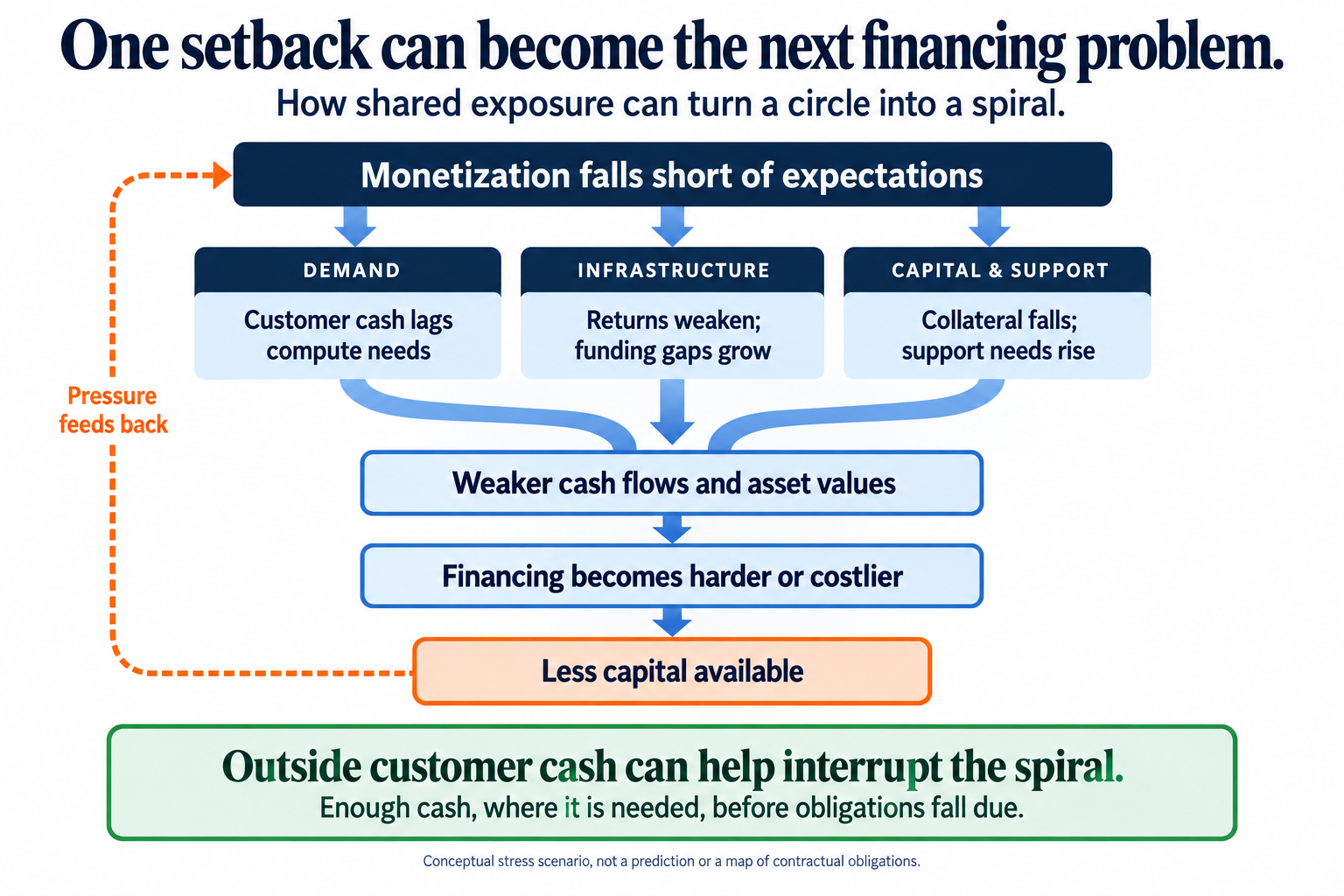
A conceptual path through which financing pressure can spread. Outside customer cash can interrupt the spiral; the sequence is not a prediction.
What I would watch now
S&P Global Ratings provides a useful outside benchmark. In August 2026, it forecast negative free operating cash flow for each company in its six-company hyperscaler group in 2026 and 2027, with recovery projected for 2029. That is a forecast, not an outcome, and its group includes SpaceX alongside Alphabet, Amazon, Microsoft, Meta and Oracle. [20]
That leaves me with six indicators I would watch.
OpenAI and Anthropic: Are revenue and gross cash economics converging toward self-funding?
CoreWeave: What does the next dollar of financing cost?
Oracle: How much contracted demand actually converts into cash and acceptable returns?
SoftBank: What happens to loan-to-value and refinancing capacity if AI asset values decline?
NVIDIA: How much cash does NVIDIA receive from the ecosystem relative to the capital it recycles back into it?
Outside customers: Is independent customer cash growing faster than the capital required to support the infrastructure?
Alongside those indicators, I would track IREN’s committed spending against secured funding and SB Energy’s project funding, customer concentration, and completion milestones. A financing problem can travel through a customer or project before it appears in a supplier’s reported results.[21]
Back to the circle
If outside customer cash grows fast enough, the circle can become less dependent on financing. Guarantees can expire under their terms, debt can be repaid, and infrastructure can earn its return. What looked circular becomes an ecosystem financing its own expansion.
If capital requirements increase more quickly than external cash, it can create a spiraling effect. Delayed returns from one company turn into refinancing issues for others. A decrease in asset value reduces the borrowing base. Guarantees that seemed unlikely suddenly become significant. The company with the strongest balance sheet is often asked to supply the next funds.
History offers an uncomfortable distinction: you can be right about the future and still be the wrong owner at the wrong price. The technology itself didn't need to fail for the financing to collapse. A company that remains sufficiently liquid to transact despite shifts in perceived value may be able to acquire useful assets at a different price.
By the time I finished the loop, the question had changed. It wasn’t just where the money went. It was who could afford another lap.
Source notes
[1] Author’s analysis of overlapping cash-flow dependence. FTC, Partnerships Between Cloud Service Providers and AI Developers, January 2025, section 4.3. Historical evidence window; current arrangements may differ. https://www.ftc.gov/system/files/ftc_gov/pdf/p246201_aipartnerships6breport_redacted.pdf NVIDIA, SB Energy and OpenAI, PORTS-Pike project announcement, August 2026. Announced plans and contingent support are not completed capacity or realized losses. https://www.sec.gov/Archives/edgar/data/1045810/000104581026000069/sbeoainvidia-portsrelease.htm
[2] Historical context for the author’s comparison: Union Pacific, Running the Railroad, historical account of the 1893 receivership and 1897 foreclosure transfer. https://www.up.com/about-us/history/overview/post-construction Ben Bernanke, Will Business Investment Bounce Back?, Federal Reserve, April 24, 2003. Contemporary analysis of telecom overinvestment and changing expectations. https://www.federalreserve.gov/boarddocs/speeches/2003/200304242/
[3] Meta, June 30, 2026 Form 10-Q, Note 5. Residual-value guarantee payments depend on termination/nonrenewal, specified conditions and a value shortfall. https://www.sec.gov/Archives/edgar/data/1326801/000162828026050705/meta-20260630.htm
[4] Lucent, SEC-filed 2002 financial statements, Note 24, Non-Derivative Instruments and Customer Financing Commitments. https://www.sec.gov/Archives/edgar/data/1006240/000095011703000724/ex99-1.htm
[5] Ben Bernanke, Will Business Investment Bounce Back?, Federal Reserve, April 24, 2003. Contemporary analysis of telecom overinvestment and changing expectations. https://www.federalreserve.gov/boarddocs/speeches/2003/200304242/ ITU, Global Connectivity Report 2025, long-run internet adoption. https://www.itu.int/itu-d/reports/statistics/global-connectivity-report-2025/
[6] Union Pacific, Running the Railroad, historical account of the 1893 receivership and 1897 foreclosure transfer. https://www.up.com/about-us/history/overview/post-construction
[7] FERC, State of the Markets 2004, printed pp. 59–60. Aggregate generation surplus coexisted with local capacity constraints. https://www.ferc.gov/sites/default/files/2020-05/20050615093455-06-15-05-som2004.pdf NRG, May 14, 2003 bankruptcy announcement; planned continuation of ordinary operations. https://investors.nrg.com/node/10256/pdf Mirant, 2003 Form 10-K, Chapter 11 discussion. https://www.sec.gov/Archives/edgar/data/1010775/000104746904012436/a2132966z10-k.htm GE, 2002 Form 10-K, Liquidity and Cash Flows; decline in new Power Systems equipment orders and progress collections. https://www.sec.gov/Archives/edgar/data/40545/000004054503000016/frm10k.htm
[8] NVIDIA, Q2 FY2027 CFO commentary, Balance Sheet and Cash Flow. Companywide operating cash flow; extended customer payment terms affect collection timing. https://www.sec.gov/Archives/edgar/data/1045810/000104581026000073/q2fy27cfocommentary.htm Broadcom, Q3 FY2026 financial results. Companywide cash generation includes semiconductor and infrastructure-software businesses. https://investors.broadcom.com/news-releases/news-release-details/broadcom-inc-announces-third-quarter-fiscal-year-2026-financial
[9] NVIDIA, Form 10-Q, quarter ended July 26, 2026, Notes 6, 8 and 10 and related risk factors. https://www.sec.gov/Archives/edgar/data/1045810/000104581026000075/nvda-20260726.htm The retained-cash question and potential need for further support are the author’s analytical framework; no net cash-extraction amount is calculated.
[10] Microsoft, FY2026 fourth-quarter and full-year results, cash-flow statements. https://www.microsoft.com/en-us/investor/earnings/fy-2026-q4/press-release-webcast Alphabet, June 30, 2026 Form 10-Q, cash flows and liquidity. https://www.sec.gov/Archives/edgar/data/1652044/000165204426000071/goog-20260630.htm Meta, Q2 2026 results, cash-flow statements. https://www.sec.gov/Archives/edgar/data/1326801/000162828026050596/meta-06302026xexhibit991.htm
[11] Amazon, Q2 2026 results, July 30, 2026. Operating cash flow and free cash flow cited cover the trailing twelve months and the whole company. https://www.aboutamazon.com/news/company-news/amazon-earnings-q2-2026-report
[12] CoreWeave, Form 10-Q, quarter ended June 30, 2026, Liquidity and Capital Resources, pp. 46–47, and indebtedness risk, p. 92. Liquidity includes undrawn facilities; management’s sufficiency statement is conditional. https://www.sec.gov/Archives/edgar/data/1769628/000176962826000366/crwv-20260630.htm
[13] Oracle, Form 10-Q, quarter ended August 31, 2026, Note 6, p. 13. Approximately $322 billion is the sum of the two cited multiyear commitment categories, not a present cash call or total liabilities. https://www.sec.gov/Archives/edgar/data/1341439/000119312526389274/orcl-20260831.htm
[14] IREN, Form 10-K, year ended June 30, 2026, AI Cloud Services risks, pp. 57–58; Notes 2 and 29, F-11 and F-61. Commitments exclude subsequent contracts. https://www.sec.gov/Archives/edgar/data/1878848/000187884826000052/iren-20260630.htm
[15] SoftBank Group, Risk Factors, as of June 22, 2026, financing and asset-sale risks. https://group.softbank/en/ir/investors/management_policy/risk_factor
[16] Microsoft, The next phase of the Microsoft-OpenAI partnership, April 27, 2026. Disclosed interests do not constitute a rescue obligation. https://blogs.microsoft.com/blog/2026/04/27/the-next-phase-of-the-microsoft-openai-partnership/ Anthropic, Anthropic and Amazon expand collaboration for up to 5 gigawatts of new compute, April 20, 2026. Company-reported revenue, investment and commitments. https://www.anthropic.com/news/anthropic-amazon-compute
[17] Stanford HAI, 2025 AI Index, Chapter 1, Inference Cost, Figure 1.3.22. Fixed MMLU performance threshold; 3:1 input/output token-price weighting; November 2022–October 2024. https://hai.stanford.edu/assets/files/hai_ai-index-report-2025_chapter1_final.pdf Cottier, Snodin, Owen and Adamczewski, LLM inference prices have fallen rapidly but unequally across tasks, Epoch AI, March 12, 2025. https://epoch.ai/data-insights/llm-inference-price-trends
[18] EIA, U.S. crude oil production efficiency continues to improve, May 2018. https://www.eia.gov/todayinenergy/detail.php?id=36012 Balke, Jin and Yücel, The Shale Revolution and the Dynamics of the Oil Market, Dallas Fed Working Paper 2021, June 30, 2020. Model-based analysis. https://www.dallasfed.org/research/papers/2020/wp2021 Dallas Fed Energy Survey, Q1 2016, respondent comments on prices, financing and distress. Individual accounts are not population-wide causal estimates. https://www.dallasfed.org/-/media/documents/research/surveys/des/2016/1601/des1601.pdf
[19] The comparison of time and financial flexibility is the author’s analysis of disclosed funding needs and commitments. CoreWeave, Form 10-Q, quarter ended June 30, 2026, Liquidity and Capital Resources, pp. 46–47, and indebtedness risk, p. 92. Liquidity includes undrawn facilities; management’s sufficiency statement is conditional. https://www.sec.gov/Archives/edgar/data/1769628/000176962826000366/crwv-20260630.htm Oracle, Form 10-Q, quarter ended August 31, 2026, Note 6, p. 13. Approximately $322 billion is the sum of the two cited multiyear commitment categories, not a present cash call or total liabilities. https://www.sec.gov/Archives/edgar/data/1341439/000119312526389274/orcl-20260831.htm
[20] S&P Global Ratings, AI Infrastructure Investment To Exceed $1.3 Trillion By 2027, August 27, 2026. Forecast for Alphabet, Amazon, Microsoft, Meta, Oracle and SpaceX; not a rating action. https://press.spglobal.com/2026-08-27-AI-Infrastructure-Investment-To-Exceed-1-3-Trillion-By-2027,-S-P-Global-Ratings-Says
[21] NVIDIA, SB Energy and OpenAI, PORTS-Pike project announcement, August 2026. Announced plans and contingent support are not completed capacity or realized losses. https://www.sec.gov/Archives/edgar/data/1045810/000104581026000069/sbeoainvidia-portsrelease.htm